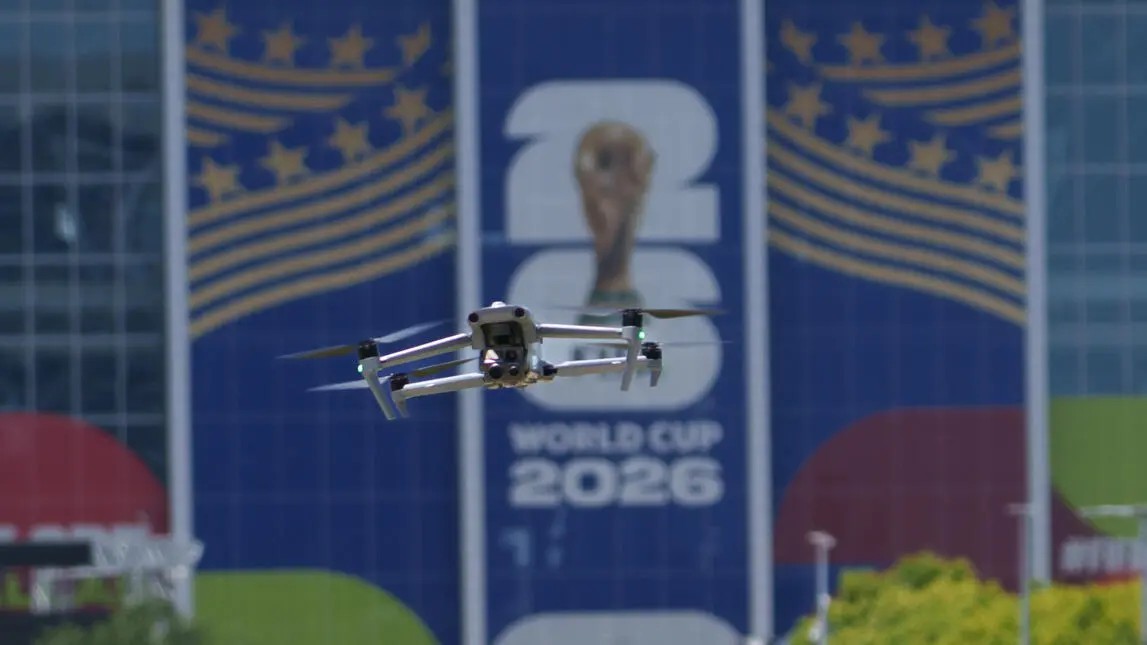
A small dot appeared on a monitor. It wasn’t a glitch. It was an unauthorized drone slipping toward a no-fly zone at AT&T Stadium in Arlington, Texas. Seconds later, a friendly interceptor swooped in, guiding the intruder away.
No radar. No dedicated surveillance hardware.
Just 5G cell towers.
This wasn’t magic. It was a live proof-of-concept demo by AT&T and Ericsson showcasing Integrated Sensing and Communication (ISAC) technology. They used the same 5G radios that power your smartphone to track the rogue aircraft. The result? Real-time detection of low-altitude threats using existing cellular infrastructure.
The implications stretch far beyond World Cup security. If this works for drones, it works for vehicles. People. Anything moving within range.
Tracking Drones With 5G: The Multistatic Sensing Setup
The demo relied on what engineers call a “multistatic sensing configuration.”
Three cell towers. Each equipped with Ericsson’s Massive MIMO (Multiple-Input Multiple-Output) radios. The sensing feature was turned on. The towers sat about 1.6 miles from the action.
When the intruder drone entered the network’s view—well outside the immediate no-fly zone—the software kicked in. Signal processing combined with AI algorithms classified the object. It identified it as a drone flying at roughly 11 mph.
If this had been a genuine threat, the data would have flowed live to law enforcement and the Department of HomelandSecurity. They could have acted.
AT&T claims the system can track swarms. The demo only involved two drones, but the architecture supports scaling up.
“We’re also closer to the ground… we can go down to a lower altitude [than traditional radar].”
— Robert Soni, VP of Radio Access Network Technology, AT&T
Why Cellular Networks Beat Traditional Radar
Radar has dominated airspace monitoring for decades. It scans high. It requires specialized, often bulky hardware.
Cellular networks offer something radar can’t easily match: density.
The US is crisscrossed with towers. AT&T alone operates around 75,000 sites. Building a radar network with that kind of coverage would be prohibitively expensive and time-consuming.
But there’s more.
Traditional radar looks up. Cell towers look around.
Their angle of elevation allows them to detect objects flying at low altitudes—specifically 300 to 400feet in this demo. The detection range extends up to 6 kilometers.
Akhil Gokul at Ericsson put it simply: more towers mean better accuracy.
“You get reflections from multiple towers… you get a much richer set of data.”
— Akhil Gokul, VP and Head of Technology for the Americas, Ericsson
Richer data means better AI classification. Fewer false positives. And crucially, resilience.
Cellular networks are designed to handle failures. If a tower goes down for maintenance or gets knocked out by a storm, the system compensates automatically. There is no single point of failure.
Breaking the Cycle: 5G Today, Not 2030
The technology demonstrated here is slated for eventual inclusion in 6G standards.
Most companies would wait. They’d follow the old playbook: standards first, proof of concept second, trials third, deployment years later. 6G isn’t expected to roll out commercially until around 2030.
AT&T and Ericsson decided not to wait.
“We’re trying to break that cycle… by introducing this early,” Robert Soni said.
Why rush? Because threats don’t wait for standards.
From the 700 drones confiscated by US agencies during the World Cup to the elusive drones seen in conflicts in Ukraine and Russia, the threat landscape is evolving rapidly. Planners for future events, like the 2028 Los Angeles Olympics, need solutions that work now, not in a decade.
The appeal of ISAC lies in its practicality. You aren’t retrofitting towers with expensive, new hardware. You’re unlocking capability already present in the ground.
“You always want to drive to see what you can already do with your existing infrastructure.”
— Yigal Elbaz, Senior VP and Network CTO, AT&T
This isn’t just about stopping bad actors. It’s about expanding the utility of the wireless grid. Autonomous vehicles could benefit from this sensing data. Traffic monitoring could become smarter. The network does more than carry your texts. It watches your world.
The Texas demo was small. Quiet. Just two drones near an empty stadium. But the signal it sent through the industry is loud.
We’re using the infrastructure of tomorrow to secure today. And we’re doing it without building a single new radar.
What else is the network hiding in plain sight?