The Communications, Space and Technology Commission in Riyadh dropped its 2025 Saudi Internet Report. It is a detailed snapshot of the country’s digital nervous system. Half of the nation’s internet users are now actively using artificial intelligence tools.
This isn’t about hype. It’s about habit.
AI adoption in Saudi Arabia has reached 45.2% of internet users. That is a significant shift from early experimentation phases. People are not just testing the waters; they are integrating these tools into daily workflows. The report highlights that nearly half of the online population relies on AI, often for the most fundamental digital task: searching for information.
Who is actually using AI in Saudi Arabia?
The data reveals a sharp divide based on demographics. It isn’t uniform.
AI adoption by gender shows a clear skew toward women. According to the report, 52.8% of female internet users employ AI tools. Compare that to 39.4% of male users. It’s a substantial gap. Women in Saudi Arabia are leading the charge on AI utility, at least in terms of reported adoption.
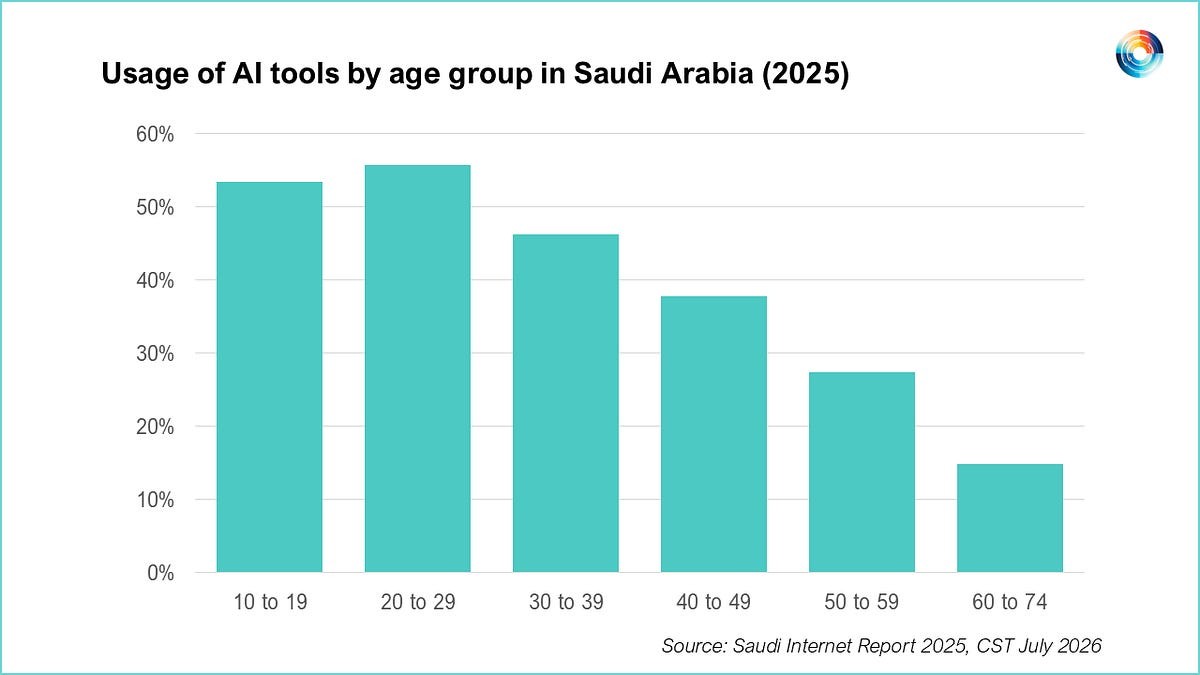
Age is the other dominant factor. The younger you are, the more likely you are to use AI.
- 10 to 19-year-olds : 58.4% adoption
- 20 to 29-year-olds : 55.7% adoption
- 50 to 59-year-olds : Drops to 27.4%
- 60 to 74-year-olds : Plummets to just 14.8%
This gradient suggests that AI literacy campaigns should target older demographics. They are lagging significantly behind the teen and young adult cohorts.
What do they use it for?
Most people aren’t building robots. They are looking for answers.
Information search is the undisputed king of use cases, capturing 80.8% of user activity. This confirms that AI has become a superior search engine for many. Beyond that, users turn to AI for idea generation (40.1%) and study or educational support (37.7%).
Creative tasks follow. Roughly 25.7% of users generate images, videos, or presentations using AI.
The professional sector? Surprisingly quiet. Only 17.3% use AI for work-related tasks. Writing sits at 14.3%, and programming or technical jobs lag even further at 13.5%. The gap between personal utility and professional integration is wide. Why? That remains an open question for enterprise tech leaders in the region.
Which apps are dominating the market?
If you want to know the hierarchy of AI apps in the Kingdom, the download charts don’t lie.
ChatGPT is the most downloaded AI application. It holds the top spot comfortably. It is followed by Google’s Gemini and the Chinese-originated DeepSeek. Grok and Microsoft Copilot also make the list.
Local competition is present but minor in terms of volume. The Kingdom’s own HUMAIN AI app rounds out the top ten, ranking tenth. The dominance of foreign models suggests that global players currently offer the utility Saudi users demand.
The backbone: Speed and connectivity
AI doesn’t operate in a vacuum. It requires robust infrastructure. Saudi Arabia is delivering on that front.
Mobile internet users in the Kingdom consume an average of 53 GB of data per month. That is three times the global average. High consumption fuels high usage.
Speed is equally impressive. The median mobile download speed hits 216 Mbps. This places Saudi Arabia among the top five G20 countries for this metric. Fast pipes are essential for heavy AI processing, whether it’s uploading large files or querying large language models in real-time.
Staying connected
The commitment to digital infrastructure extends beyond mobile networks. 61.3% of users spend seven hours or more online every single day. That is intense engagement.
Trust in the digital environment is also rising. Domain name registrations have grown by 18% annually. People are registering local domains. They are putting their content there.
The report includes a note that it was written and edited with the assistance of AI. A fitting touch for a document detailing the era of automation.
The numbers tell a story of rapid normalization. AI is no longer the future for Saudi internet users. It is the present. The question now is whether the professional sector will bridge the gap between personal search habits and workplace productivity. For now, the gap remains.