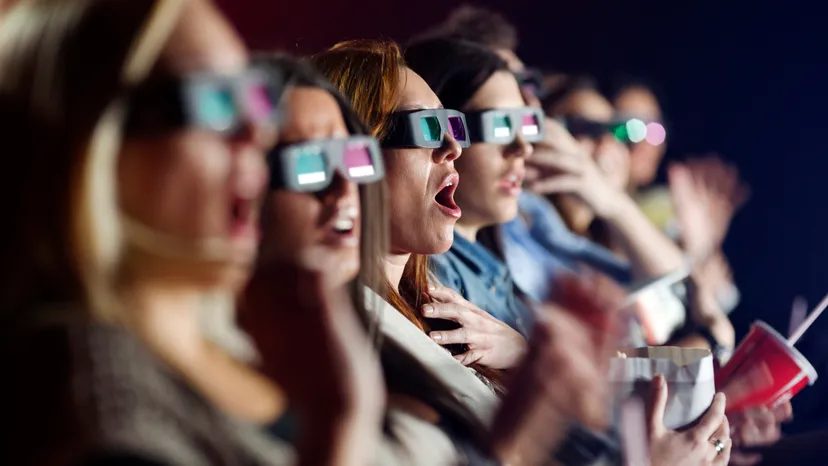
Remember the frustration of peering through those heavy, red-and-blue anaglyph glasses? Or the awkward dance of trying to converge your eyes on fuzzy dot patterns? That era is over. The gap between how we see and what screens show has finally closed.
Today’s hardware is in a different league. We have processors dedicated to rendering complex geometry, and scientists finally understand the mechanics of human vision better than ever. Combine those two forces, and 3-D graphics stop being a novelty and start becoming a standard expectation.
Most of us cut our teeth on 3-D gaming. Think back to the early nineties. Wolfenstein 3D blew minds. It was a maze of blocky tiles, sure. But you could walk forward, turn left, and spin your view 360 degrees. It felt revolutionary. Now, games offer realistic lighting and physics engines that simulate real-world collisions. The visuals are stunning. They are also fundamentally flawed. The output lives on a flat LCD or OLED panel. No matter how deep the world looks, you are staring at glass.
That is where PC 3-D glasses become essential. They are not just accessories. They are tools designed to hack your brain’s processing center. They convince your visual cortex that the flat image on your monitor is actually a solid, volumetric object. To grasp how this magic happens, we have to look at what your eyes are actually doing.
The Mechanics of Stereoscopic Vision
Your brain does not just receive images. It constructs them. It takes the slightly different perspective from your left eye and your right eye and merges them into a single perception of depth. This is called stereopsis. Without that disparity between the two views, the world looks flat. 3-D glasses force that disparity back into the picture. They split the signal. One lens shows one version. The other lens shows another. Your brain fills in the rest.
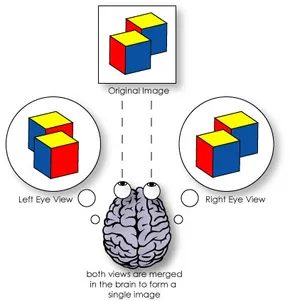

Humans come standard with two eyeballs. They sit side by side. This isn’t just a design quirk. It forces each eye to capture the same scene from a slightly offset angle.
Try it yourself. Pick a distant object. Close one eye. Then the other. Notice how the background objects seem to shift? That’s the gap.
The brain doesn’t just store these two images separately. It stitches them together. It interprets those tiny differences as depth. The result is a single, three-dimensional picture. Height. Width. Depth. All at once.
This stereoscopic vision isn’t just a party trick. It’s a survival mechanism. Or at least, that’s what many evolutionary biologists argue.
The added perception of depth allows us to gauge exactly where surroundings are in relation to our bodies.
Without it, the world looks flat. Like a movie poster. We lose the ability to judge distances with any real precision.
Think about the things we do daily. Throwing a ball. Catching it. Driving a car. Parking in a tight spot. Even threading a needle. These all rely on depth perception.
Can you manage without it? Sure. But it becomes tedious. Every movement requires conscious calculation. Your brain has to infer distance rather than knowing it instantly.
For most of us, stereoscopic vision is automatic. We don’t think about it until it’s gone.
Why It Matters for Everyday Tasks
The positioning of our eyes gives us a unique advantage: partial occlusion. We can see partially around solid objects without turning our heads.
This helps us spot dangers before they hit us. A car pulling out. A branch swinging low.
It also helps us navigate cluttered spaces. We know exactly where our hands are in relation to the table. Without that depth perception, simple tasks become complex puzzles.
You might wonder: if we have two eyes, why is 3D vision so fragile?
It’s not just about having two eyes. It’s about how the brain processes the disparity. If that processing fails, the world loses its third dimension.
The Evolutionary Advantage
Some believe this evolved primarily for predation and evasion. Spotting prey moving toward us. Seeing predators in the bushes.
We are particularly good at spotting objects moving toward or away from us. That’s a key survival skill.
But it’s not just for hunting. It’s for navigating. Knowing when to step off a curb. When to grab a handrail.
The precision is considerable. We hit targets without aiming carefully. We catch objects we didn’t see coming.
All because of those two side-by-side sensors.
When Depth Fails
Not everyone experiences stereoscopic vision the same way. Some have weak depth perception. Others have none.
For them, everyday tasks are harder. Driving requires more caution. Catching a ball is a guess.
It highlights how much we take for granted. We assume the world is 3D. We don’t realize we’re building that reality in our heads.
Until something breaks the illusion.
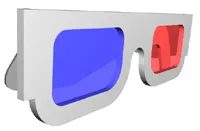

Depth perception isn’t magic. It’s biology. Your brain stitches two slightly offset images together to create the illusion of distance. We rely on this every day. We can do it with cheap red-and-blue glasses. Those filters split the image. One eye sees red. The other sees blue. The brain ignores the color mismatch and focuses on the geometry. Suddenly, a flat comic page pops into立体 space.
Stereograms work differently. They use noise. Random dot patterns hide a shape. You have to cross your eyes or stare through the image until the brain finds the overlap. It’s a parlor trick. It’s impressive. It’s also terrible for gaming.
Why? Because neither method is built for interaction. Anaglyph glasses ruin color fidelity. You can’t judge depth accurately if everything looks like a sepia-toned nightmare. Stereograms require you to stop playing and start straining. You can’t hold a controller while trying to force your eyes out of alignment.
The industry needed something better. Something that didn’t require props or patience.
Building the Scene
The solution lies in how we render worlds.
Decades ago, games were 2D sprites. You drew a dinosaur. You drew it from the left. You drew it from the right. You drew it running. Every frame was hand-crafted. If you wanted to look around the dinosaur, you needed a pre-drawn image for that angle. It was labor-intensive. It was static.
Then came 3D modeling.
Designers now build digital sculptures. A dinosaur is a mesh of polygons. It exists in virtual space with coordinates. The computer doesn’t need to draw the dinosaur. It knows where the dinosaur is. It knows where the camera is. It calculates the projection.
This is the key. The computer generates a view based on a single point of origin. This is the left eye.
But the computer is fast. It can calculate another view. Just slightly offset. This becomes the right eye.
Two images. Two perspectives. One scene.
Syncing the Eyes
Generating the images is the easy part. Modern GPUs do this effortlessly. The hard part is delivery. How do you get the left image to the left eye and the right image to the right eye without confusing the viewer?
The industry settled on shutter technology. Active shutter glasses.
These aren’t passive filters. They are electronic devices. They sync with the monitor. The monitor displays the left eye’s image. The glasses darken the right lens. Then the monitor flips to the right eye’s image. The glasses darken the left lens. This happens dozens of times per second.
The result? A seamless 3D experience. No color loss. No eye-crossing. Just depth.
But it’s not perfect. The glasses are heavy. The batteries die. The sync can lag. And that lag breaks the illusion. If the images don’t match up exactly, your brain rejects the input. You get headaches. You get nausea.
Still, it was a massive leap forward. It turned 3D from a novelty into a playable format.
The next step was removing the glasses entirely. Parallax barriers. Lenticular lenses. Holographic displays. Each attempt tried to solve the delivery problem without forcing you to wear hardware.
Some worked. Some didn’t. The technology evolved. But the core principle remained unchanged.
Two images. One brain. Depth.
The challenge wasn’t just creating the images. It was making them comfortable. Sustainable. Invisible.
We got there. Mostly. But the quest for the perfect display continues. Because once you see true depth, going back to flat feels like a compromise. A necessary one, perhaps. But a compromise nonetheless.

How Active Shutter Glasses Actually Work
It comes down to liquid crystal displays. You know the tech. It’s in your watch, your phone, your monitor. The crystals shift from transparent to opaque when voltage hits them. That’s all active shutter 3-D glasses are doing. They aren’t magic. They’re just LCDs on your face.
The glasses control which eye sees what. Timing is everything. If the sync is off, you get ghosting. If it’s on, you get depth.
Here is the mechanism, stripped of the marketing fluff:
The computer generates two distinct images. One for the left eye. One for the right. These aren’t just slightly different angles. They are parallax-separated views that mimic human binocular vision. The brain fuses them into a single 3-D image.
These views hit the screen in rapid sequence. Not simultaneously. Sequentially. Left eye image. Right eye image. Left eye image. Right eye image.
The Synchronization Problem
This is where most consumers trip up. The glasses have to know exactly when each frame appears. If the left eye image is on screen but the left lens is closed, you see nothing. Or worse, you see the next frame with the wrong eye.
The glasses don’t just guess. They rely on a signal. Usually infrared or radio frequency. This signal tells the shutter to close the left lens and open the right, or vice versa. The frequency matters. 120Hz screens? That’s 60Hz per eye. Fast enough to avoid flicker. Slow enough to keep battery life from tanking in ten minutes.
Why Passive Doesn’t Need Batteries
Contrast this with passive polarized glasses. You know the ones. Red and blue filters. Or linear polarization. You don’t need a battery in those lenses. They’re just filters. But they have limits. Resolution drops. Brightness drops. You can’t tilt your head.
Active shutter glasses? They preserve full resolution. Each eye gets the whole frame. But they’re heavier. More expensive. And they die if you forget to charge them.
The Latency Lag
There’s another layer. Input lag. The computer renders the left frame. Sends it to the GPU. The GPU pushes it to the display. The display shows it. The glasses get the sync signal. The lenses switch.
Each step adds milliseconds. In a shooter game, those milliseconds matter. In a cinematic experience? Less so. But the lag is real. It’s not instantaneous. It’s a chain of events. And every link in that chain introduces delay.
Which Glasses Actually Last?
Not all active shutter glasses are equal. Some brands use proprietary protocols. Others use standard Bluetooth Low Energy. Some sync via the TV’s own IR blaster. Others have built-in transmitters. Compatibility is a mess. A Samsung TV might not talk to Vizio glasses. A Logitech headset might choke on a Dell laptop’s USB port.
Check the specs. Really. Don’t assume all “active 3-D” glasses work with all “3-D capable” displays. The handshake protocol matters. The refresh rate matters. The response time of the LCD crystals matters. If the crystals are slow, you get smear. Ghosting. The illusion breaks.
What About VR?
VR headsets use a similar principle.

How active shutter technology manipulates your vision
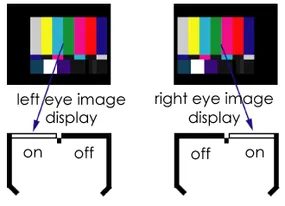
You have to look at the timing to really get it. The system is split down the middle. The left image goes to your left eye. The right image goes to your right. But they don’t happen at the same time.
Instead, the glasses act as a high-speed gatekeeper. When the screen displays the left-side perspective, the lens over your right eye goes dark. It blocks the view. You see only the left angle. Then the screen flips. Now it shows the right perspective. The left lens darkens instantly. The right lens opens up.
Why synchronization is everything
This back-and-forth is what tricks your brain. You get two slightly different images. One for each eye. Your visual cortex merges them into a single 3D image. It works because of the glasses. Specifically, liquid crystal lenses. These lenses can switch from transparent to opaque in microseconds.
The monitor refreshes at a high frequency. Usually double the standard rate. One refresh for the left eye. One for the right. The glasses sync with this signal. They open and close in perfect rhythm. If the timing is off. The image breaks. You get ghosting. Double vision. Or just a headache.
The trade-off for depth
There is a cost to this precision. Brightness drops. Since each eye only sees half the frames. The screen has to work twice as hard to maintain luminance. Many active shutter systems dim the overall picture to compensate.
Also, you need a power source. The glasses aren’t just plastic frames. They contain batteries and electronics. They are heavier than passive polarized ones. And they need to be charged. Passive systems use cheap filters. Active ones use expensive, complex tech.
Comparing active shutter to passive alternatives
Which is better? It depends on what you value.
Active shutter offers full resolution for each eye. Every pixel on the screen is seen by one eye at a time. No resolution loss. But it requires expensive glasses. And those glasses are heavy. They clamp on your face. They need batteries.
Passive 3D uses polarized filters. Like the ones at movie theaters. The screen displays interleaved lines. Your left eye sees one set. Your right eye sees the other. Resolution is halved. But the glasses are cheap. Lightweight. No batteries needed.
Active shutter wins on clarity. Passive wins on comfort and cost.
Where this tech is used today
You won’t find this in most home theaters anymore. The market shifted. Passive 3D became the standard for consumer TVs. It’s cheaper. Simpler. Active shutter found a niche in professional environments. Medical imaging. Engineering simulations. Where every pixel matters.
But in consumer gaming? It’s rare. Most modern consoles dropped support. The glasses were too cumbersome. Too expensive. The novelty wore off.
Still. The principle remains. Split the view. Block one eye. Show the other. Repeat fast enough. And your brain fills in the gap. It’s simple physics. Complicated execution.

Your brain doesn’t process the left-eye and right-eye images separately. It stitches them together instantly. The merging happens below the level of consciousness. You just see depth.
It works like the persistence of vision in old film projectors. Still frames flicker past your eyes. Your brain blends them into motion.
The Evolution of Stereoscopic Tech
We often assume modern 3-D is simple magic. It isn’t. It’s the result of four distinct generations of hardware and software compromises. The early days were messy.
Generation one required developers to hard-code support. Studios had to build specific compatibility for each brand of LCD glasses. If you bought glasses that didn’t match the game’s protocol, you got a flat image. It was a fragmented ecosystem. Most gamers ignored it.
Generation two took a different approach. It bypassed the game entirely. A third-party application intercepted the computer’s output, splitting the screen and modifying the feed. The game ran normally, unaware it was being manipulated. But this hack demanded heavy processing power. The result? Slower frame rates. Blocky, low-resolution visuals. It worked with hundreds of titles, which was its only real selling point.
Generation three improved upon the interception method. It hooked into the graphics driver instead. This preserved image resolution. No more pixelated blocks. However, driver-level hacks were finicky. Compatibility remained spotty across different hardware configurations. It was a stepping stone, showing that high-fidelity 3-D was possible without developer buy-in.
Generation four is the current standard. The heavy lifting moves to the graphics card (GPU). The glasses themselves are lightweight LCD shutter pairs. They flicker between left and right views at a high frequency. The brain blends the rapid alternation into a single, clear, stereoscopic image. Compatibility is high. Performance impact is minimized.
So what matters when you’re looking to buy? Not every pair performs the same. Here is what actually separates the usable hardware from the e-waste.
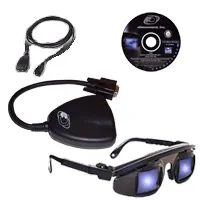

Picking the Right 3D Glasses
The tech underneath is mostly the same across the board. You will find lightweight wireless models and basic wired pairs that cost less. Your computer’s graphics card matters more for image quality than the brand of glasses. Manufacturers often add extra software or minor incentives to differentiate their products.
Shop around. If you can try a pair on before buying, do it. Imagine wearing them for an hour of intense gaming. You might need to spend a bit more for a better model.
Health and Hardware Warnings
All glasses carry the standard video game warning. Epilepsy, eye-strain, and tiredness are real risks. If a flat monitor gives you trouble, test these glasses first. They are harder on the eyes.
Compatibility is another issue. Current 3-D glasses often fail with LCD flat-panel monitors. Check this before you buy. You need to know your video card maker and model. Research before purchasing.
Take the X-Force 3D Game Glasses. They only work with nVidia video cards. Some glasses support multiple cards. Reading the box is the only sure way to know.
Understanding NVIDIA 3D Vision
NVIDIA 3D Vision is a specific technology. It enables stereoscopic vision for gaming and computing. The glasses emit two different images. Your brain combines them into a three-dimensional image.
Explore More on 3D Tech
If you want deeper details, look at the links below. They cover the mechanics behind the hype.
Related Articles
- How 3-D Graphics Work
- How Holograms Work
- How Shockwave 3-D Technology Works
- How the Elumens Vision Station Works
- How Stereolithography 3-D Layering Works
- How 3DO Creates Video Games
- How Video Game Systems Work
- How is digital 3-D different from old 3-D movies?
- How do developers get such realistic environments in video games?
External Resources
- Optometrists Network: Stereo Vision
- The Museum Of Unnatural Mystery: Stereoscopic Vision
- Magic Eye
- nVidia: 3D Glossary
- StereoGraphics Corporation: White Papers