


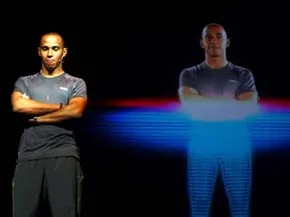
The Holodeck wasn’t just a cool set piece in Star Trek. It was a blueprint. Fans watched the Enterprise crew step into a room where holograms felt solid, touchable, and real. Today, engineers are finally building the infrastructure to make that sci-fi fantasy a tangible reality. We are moving toward a communication network that lets you and your friends interact inside a shared simulated space, regardless of whether you are in the next room or thousands of miles apart.
The core components for this tele-immersion technology are already online. It is the academic and industrial response to the Holodeck. Videoconferencing has already proven that we can exchange rich data in real-time without physical proximity. Tele-immersion takes that concept and shatters the limitations of flat screens. It creates a central, simulated environment where everyone gathers virtually. No one leaves their desk.
Imagine employees in Los Angeles, New York, Tokyo, and Paris meeting in this new space. They will shake hands with colleagues who exist only as high-fidelity projections.
Beyond the Flat Screen: Why Traditional Videoconferencing Fails
In the future office, you won’t dial a number. You’ll command your system. “Computer, call Joe in London.” Suddenly, your office wall flickers. Joe is sitting across from you. On his end, the experience is mirrored. This is the promise of tele-immersion: bringing distant people into a single, shared spatial context. Business travel becomes obsolete.
Current videoconferencing solutions are broken. We’ve all endured the lag. The video jerks. The audio desyncs. More importantly, the view is static. If you stand up and walk out of the webcam’s narrow field of view, you vanish from the conversation. You are a pixelated head on a stick.
Tele-immersion fixes this. You cannot walk out of the camera’s view because the camera captures the entire room. You can look around your colleague’s office by shifting your perspective on the display. It functions like a window into their physical reality, not a flat portrait.
The Engine Behind The Hologram
Creating these environments requires computing power that dwarfs your average home PC. The process is a three-step loop that happens in milliseconds:
- Recognition: The system identifies the presence of people and objects in the physical room.
- Tracking: It maps their movements in 3D space.
- Projection: The data is sent to a stereo-immersive surface for the remote user.
This isn’t just theoretical. In May 2000, researchers from the University of North Carolina (UNC), the University of Pennsylvania, and Advanced Networks and Services hit a major milestone as part of the National Tele-Immersion Initiative (NTII). A user at UNC in Chapel Hill saw lifelike, three-dimensional images of colleagues in Philadelphia and New York. The latency was low enough that the interaction felt immediate.
Tele-Immersion vs. Virtual Reality: What’s The Difference?
People often confuse these technologies. They are not the same. Virtual reality (VR) places you inside a fully computer-generated 3D world. You can walk through digital forests. You can pick up virtual swords. Tele-immersion, at this stage, is different. It creates a 3D view of the real world. You see your actual colleague, rendered in 3D, but you cannot currently interact with the physics of the room or alter the scene.
The next leap involves merging these fields. Imagine a VR environment where you can manipulate objects, overlaid with real tele-immersive participants.
Real-World Applications
The utility extends far beyond boardrooms. Consider gaming. Imagine a world without joysticks. You are inside the game. You fight monsters. You score touchdowns. Your body movements control the action directly.
Travel changes too. You don’t fly to see your family for the holidays. You summon them into a shared holographic room. Eventually, haptic feedback might allow for a physical sensation of touch. Even high-stakes professions stand to benefit. Doctors can train in simulated surgeries with remote experts. Soldiers can rehearse combat scenarios in photorealistic environments without leaving the base.
Holographic Displays
The hardware behind early tele-immersive systems feels less like consumer electronics and more like a laboratory experiment. Users don’t just sit in front of a screen. They strap on special goggles and a head-tracking device. This setup monitors where you are looking, allowing the system to adjust the 3-D image in real time.
On the other side of the connection, the process is equally technical. Seven standard video cameras track the person being projected. Two additional cameras capture the actual light patterns in the room. These lights help calculate precise distances, ensuring the depth on your screen matches reality. Move your head to the right? The image shifts exactly as it would if you were standing in that room.
The Mechanics of Polarized Depth
The screen splits and polarizes the image. Your left eye sees one version. Your right eye sees another. The goggles combine these signals. Your brain stitches them into a single 3-D picture. It is the same principle as old-school polarized 3-D movie glasses, but applied to live, remote presence.
Early tests, such as the one at UNC in May, revealed significant flaws. The experience is far from seamless. The projected scenes refresh only three times per second. This low frame rate creates a jerky image. It breaks the illusion. If the rate hit 10 frames per second, the result would be different. You would look through a window at another person, not at a slideshow of their face.
Infrastructure Bottlenecks and Future Fixes
Creating a true holographic environment requires massive computational power. Scientists are pushing several technologies to solve these issues.
- Internet2 is designed to replace current internet infrastructure. It offers speeds 1,000 times faster than today’s broadband. This bandwidth is non-negotiable for transferring the huge data streams tele-immersion generates.
- Stereo-immersive displays must evolve to present crystal-clear views of transmitted scenes. Current tech struggles with clarity.
- Haptic sensors aim to let users touch projections. The goal is tactile feedback that mimics real objects.
- Desktop supercomputers are needed to handle the trillions of calculations for holographic environments. Alternatively, a distributed network of computers could share this processing load.
From Commute to Kitchen Table
Tele-immersion threatens to erase the boundary between physical presence and digital connection. It promises to be the ultimate remote work tool. The rush-hour commute could vanish entirely. Instead of driving, you project yourself into the conference room.
Travel becomes optional for daily life. Need to attend a meeting? Tele-immersion gets you there. Need to be home for dinner? You can project into your family’s kitchen. The technology remains in its infancy. The possibilities are still wide open.
Tele-immersion will blur the lines between real and computer-generated images.
For those tracking the evolution of these systems, several resources offer deeper dives. Related articles cover holographic memory, augmented reality, and the mechanics of teleportation. Specific research hubs like Brown University’s Tele-Immersion Research and the National Tele-Immersion Initiative provide technical insights. The NSF Science and Technology Center for Graphics and Visualization also explores the underlying science.


