The race for the top spot on the TOP500 list has always been brutal. It is a competition defined by raw speed and massive power consumption. Now, the game has changed permanently. For the first time in history, a supercomputer has crossed the exascale threshold. This is not a small step. It is a leap into a new era of computing.
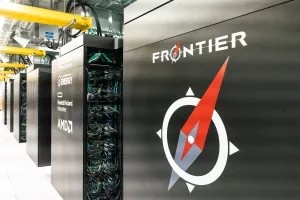
Frontier, located at the Oak Ridge National Laboratory in the United States, has achieved something unprecedented. It now processes 1.1 trillion floating-point operations per second. That number alone is hard to visualize. To put it in perspective, that is one billion billion calculations every single second. We have officially entered the exaflop range.
But what does this actually mean for the world outside the lab? And how did we get here?
Defining the Exaflop
An exaflop is one quintillion floating-point operations per second. The term comes from “flops,” which stands for Floating Point Operations. It is the standard metric for measuring supercomputer performance. Until recently, petaflops (one quadrillion) were the ceiling. Exaflops represent a thousand-fold increase.
Frontier’s achievement is not just about speed. It is about efficiency and architecture. It uses AMD EPYC processors and Radeon Instinct accelerators. This combination allows it to deliver massive performance without consuming the entire power grid of a small nation. Well, perhaps close to it.
How Is This Measured?
You might wonder how such a staggering number is derived. The value comes from the LINPACK benchmark. This is a standard test suite used to rank the TOP500 supercomputers. It solves a system of linear equations. The faster a machine can solve these complex equations, the higher its ranking.
Frontier’s score of 1.1 exaflops on LINPACK confirms its dominance. It is not a theoretical maximum. It is a measured reality. This means the hardware can sustain this level of computational density under stress. It proves that the design works. It proves that the cooling systems, the interconnects, and the software stack are all functioning as intended.
Why This Matters Now
You might ask why we need a machine that can do a quintillion calculations per second. The answer lies in complexity. Some problems are too difficult for current systems. Climate modeling requires simulating atmospheric interactions at a granular level. Drug discovery involves simulating molecular interactions with atomic precision. Artificial intelligence training demands processing massive datasets in record time.
Frontier can handle these tasks. It can run simulations that were previously impossible. It can shorten research timelines from years to months. It can accelerate scientific discovery.
Consider protein folding. Understanding how proteins fold is key to treating diseases. Frontier can simulate these processes with unprecedented accuracy. This leads to better treatments. Faster. More effectively.
The Shift in Computing Power
This is not just a victory for Oak Ridge. It is a shift in the landscape of high-performance computing. The barriers have been broken. Other labs will chase this number. They will try to surpass it. But the baseline has changed.
The exascale era is here. It brings new challenges. Energy consumption is a major concern. But it also brings new opportunities. We are no longer limited by the speed of our machines. We are limited by the complexity of the
Beyond the TOP500 Benchmarks
We measure computer power by how many operations it can crush in a second. That is the baseline. We have more cores. We have specialized accelerators. The raw speed has skyrocketed. But the official metric for supercomputing, the TOP500 list, uses a specific program. It solves massive systems of linear equations. It uses double precision, which means 64-bit accuracy. This is the gold standard for ranking.
In 1997, we hit the teraflop mark. One trillion floating-point operations per second. Then came 2008. The petaflop era began. One quadrillion operations. That was a big deal. It meant we could model complex weather patterns and protein folding with more ease. But the goal always shifted upward. The next symbolic threshold was the exaflop. One quintillion calculations per second.
Consider the scale. The universe is roughly $10^{18}$ seconds old. If a human had been solving a single problem every second since the Big Bang, an exascale computer could finish that same workload in one second. It is not just faster. It is a different dimension of time.
Real-World Science at Exaspeed
Christian Plessl from the Center for Parallel Computing at Paderborn University knows this well. He and his team recently ran a simulation at true exaflop speeds. They used the Perlmutter supercomputer at the National Energy Research Scientific Computing Center in the US. The target? The spike protein of the SARS-CoV-2 virus.
This was not a standard benchmark run. The TOP500 requires 64-bit precision. Plessl’s team used 32/16-bit precision instead. Why? For atomic-level simulation, that level of detail is often sufficient and vastly more efficient. The result was staggering. The simulation of 83 million atoms took just 42 seconds.
“The dimension of this number becomes clearer when you realize that the universe is about $10^{18}$ seconds old.”
They executed about $47 \times 10^{18}$ floating-point operations. That is 1.1 exaflops. A new world record. This proves that exascale computing is no longer a theoretical milestone. It is a working reality for scientific discovery.
Why Precision Choices Matter
The shift from 64-bit to 32/16-bit precision highlights a growing trend in high-performance computing. We do not always need maximum accuracy to get meaningful results. In many simulations, reduced precision saves massive amounts of energy and time. The TOP500 list remains important for standardized comparison. It tells us who has the most raw, double-precision power. But real science often happens in the margins.
Plessl’s team showed that we can simulate viral structures with atomic accuracy in seconds. This speed matters for drug discovery. It matters for understanding how proteins fold. It matters for responding to pandemics. The gap between ranking and reality is narrowing.
The race for the next number continues. But the focus is shifting. It is not just about the peak number on a list. It is about what we can actually do with that power. Simulating a virus spike protein in 42 seconds changes
Frontier: der erste Exascale-Rechner
Die Zahl ist jetzt offiziell. 30. Mai 2022. Die TOP500-Liste, veröffentlicht auf der Supercomputing-Konferenz in Hamburg, hat es bestätigt.
Frontier.
Der Supercomputer des Oak Ridge National Laboratory (ORNL) in den USA ist nicht nur schnell. Er ist der erste echte Exascale-Rechner der Welt. Und damit hat sich die Wissenschaftsgeschichte für immer verändert.
Die Zahlen sprechen eine klare Sprache. 1,102 Trillionen Gleitkommaoperationen pro Sekunde. Das sind 1,1 Exaflop. In der offiziellen Benchmark hat Frontier die Marke geknackt. Endlich.
“Frontier läutete eine neue Ära des Exascale-Computings ein und hilft damit, die größten wissenschaftlichen Herausforderungen der Welt zu bewältigen.”
Thomas Zacharia, Direktor von ORNL, sieht das genauso. Für ihn ist der Meilenstein erst der Anfang. Er ist der Vorgeschmack auf etwas, das noch viel größer ist. Die beispiellosen Fähigkeiten von Frontier als Werkzeug für die Wissenschaft.
Doch wie kommt man auf diese Leistung?
Frontier wurde gerade erst aufgebaut. Trotzdem beeindruckt er durch Effizienz. 8,7 Millionen Rechenkerne. Das ist die Muskulatur hinter der Rechenpower. Aber die wahre Stärke liegt in der Energiebilanz. 52,23 Gigaflop pro Watt.
Relativ energieeffizient für dieses Niveau.
In einer Welt, in der Rechenzentren ständig mehr Strom verbrauchen, ist das kein kleines Detail. Es ist ein Schlüssel. Denn Exascale-Computing bedeutet nicht nur Geschwindigkeit. Es bedeutet, komplexe Probleme zu lösen, die vorher unmöglich schienen.
Wettervorhersagen. Klimamodellierung. Genomik.
Diese Aufgaben brauchen nicht nur mehr Power. Sie brauchen die richtige Power. Die, die nicht die Welt verbrennt, während sie sie berechnet.
Frontier zeigt, dass das möglich ist.
Die Ära hat begonnen. Was als Exascale beginnt, wird sich vielleicht bald als Pionierarbeit für das post-exascale Computing erweisen. Aber das ist ein anderes Kapitel.
Erstmal geht es um das, was jetzt ist.
Die Zahlen sind da. Die Maschine läuft. Und die wissenschaftlichen Herausforderungen warten.
Scaling Past Moore’s Law: The Real Bottlenecks of Exascale Computing
Thomas Lippert and Estela Suarez from the Jülich Supercomputing Centre aren’t sugarcoating it. Getting to Exascale computing is not just a matter of buying more parts and pressing a big red button. It is a grind. Hundreds of steps. Multiple levels of complexity. And the old rules? They don’t apply anymore.
For two decades, Moore’s Law was a reliable predictor. Every ten years, processor performance skyrocketed by a hundredfold. Combined with other supercomputing optimizations, that meant a thousandfold increase in raw power. That era is over. Since around 2005, those scaling laws have broken down. You can no longer rely on raw clock speeds or transistor density to do the heavy lifting.
The Heat Problem Is Physical, Not Just Logistical
Let’s talk about energy. This is where the rubber meets the road. A single server rack in a modern supercomputer draws 150 kilowatts of electrical power. Think about that. That is ten to fifteen times the power consumption of a heating system in an average single-family home.
If you don’t manage that heat, the system vaporizes in minutes. It’s that simple.
Ten years ago, air cooling was sufficient. Now? You need warm water cooling systems. They are more efficient. They suck the heat out before it kills the silicon. And because they capture waste heat so effectively, you can pipe it directly into building heating systems. It’s not just about keeping the computer alive; it’s about not melting the facility.
Managing Thousands of Machines
Then there is the management layer. How do you administer a system with 10,000 machines? You can’t do it manually. You can’t walk around with a USB stick.
Manual software updates are a death sentence at this scale. You need orchestrated software. You need a system that can administer the entire infrastructure autonomously. If the software layer isn’t robust, the hardware is useless.
Why We Need More Than Just “Faster”
So why go through the trouble? Why build an Exascale machine?
The answer lies in resolution. In climate simulation, we currently hit a wall. On a Petascale supercomputer, the best we can do is a 10-kilometer grid resolution for global models. We want one-kilometer resolution. We need to capture hotspots—small-scale phenomena that interact in complex ways. You can’t simulate a hurricane accurately if your grid squares are the size of a small country.
“Our philosophy is to always get better, simulate larger and more complex problems, so that at the end, we have an increasingly realistic picture of the world.”
This isn’t just about weather. It’s about molecular dynamics. It’s about drug discovery. If the computing power is higher, the simulation is more reliable. The statement you get from the computer becomes scientifically valid rather than just a rough guess.
Connecting the Unconnectable
Estela Suarez points out that accuracy is only half the battle. The other half is integration. In climate science, you can’t just model the atmosphere. You have to model the oceans. You have to model the Earth’s surface. Connecting all these variables mathematically is incredibly complex.
Neuroscience faces the same wall. We want to simulate the entire human brain. But to understand diseases, we need to look at individual neurons and their specific functions simultaneously. The current computing power doesn’t cut it. We need an Exascale machine to bridge that gap between macro-level simulation and micro-level detail.
The Shift to Heterogeneous Computing
Since clock speeds hit a physical limit due to heat and power constraints, the industry pivoted. We started packing more cores into each unit. That’s why your phone and laptop have multi-core processors.
Then, we looked elsewhere. Graphics Processing Units (GPUs). Originally built for gaming, they offer massive parallel processing power for relatively low energy consumption. Supercomputers are eating them up.
This trend will continue. We are looking at technologies that weren’t built for supercomputing but can be forced to work. Quantum computers. Neuromorphic chips that mimic the human brain.
At Jülich, they are betting on a modular architecture. You define different clusters with different hardware traits. You connect them. Users can access these modules simultaneously based on what their specific code requires. It’s not a one-size-fits-all monolith anymore. It’s a toolkit.
And it’s still not enough. We will always want to push the limits. The Exascale machine is just the next step, not the finish line.
Software: The Real Bottleneck in Exascale Computing
Everyone fixes their gaze on the silicon. The cooling systems. The sheer density of the processors. But that’s only half the battle.
Hardware is just the engine. The software is the steering wheel, the transmission, and the driver’s manual all rolled into one complex mess. If the code can’t handle the chaos, the hardware is just an expensive paperweight.
The systems are getting fractally complex. You can’t just throw more cores at a problem and expect linear scaling. The heterogeneity is the killer. You’re juggling GPUs, TPUs, specialized accelerators, and traditional CPU clusters. They all speak different languages. They all have different latency profiles. The software stack has to bridge these gaps without collapsing under the weight of its own abstraction layers.
Making the Black Box Accessible
This isn’t just about raw compute. It’s about accessibility.
Researchers aren’t sysadmins. They’re biologists, climate modelers, and astrophysicists. They don’t care about cache coherence. They care about results. The software needs to hide the complexity. It needs to present a unified interface to the end-user, even if the backend is a tangled web of specialized hardware.
We’re talking about new interfaces. Better abstraction layers. Tools that allow application codes to be ported and optimized for machines that don’t even exist yet. It’s forward-thinking engineering. You can’t optimize for a machine you’ve only seen in a whitepaper.
The DEEP-SEA Project
We’re seeing this play out in real-time. Look at the DEEP-SEA project. It’s currently underway. The goal? To develop the next generation of software packages specifically designed for exascale environments.
They’re not just patching old code. They’re rebuilding the foundation. Preparing application codes to run efficiently on future architectures. It’s about creating the middleware that will make exascale usable. Not just powerful. Usable.
Because raw power doesn’t matter if you can’t direct it.