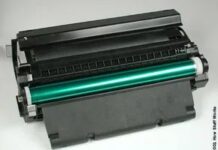
The laser assembly is stuck on a single plane. It moves only horizontally. After it finishes a scan line, the printer shifts the photoreceptor drum up one notch. This allows the laser to draw the next line below it. A small print-engine computer keeps everything synchronized. The speed is dizzying.
Not all printers use a laser beam. Some use a strip of light emitting diodes (LEDs) to write the page. Each dot position has its own dedicated light source. This means the printer has one fixed print resolution. You cannot zoom in without losing clarity. These systems cost less to manufacture than true laser assemblies. They also produce inferior results. You will typically only find them in cheaper consumer printers.
Laser printers operate on the same basic principles as photocopiers. There are significant differences though. The most obvious one is the image source. A photocopier scans a physical document by bouncing bright light off it. A laser printer receives the image in digital form.
How does the electrostatic image creation differ between the two? It comes down to charge patterns. When a photocopier bounces light off paper, the light reflects back onto the photoreceptor from white areas. Dark areas absorb the light. The “background” gets discharged. The electrostatic image retains a positive charge. This method is called “write-white.”
Laser printers reverse this process. The laser discharges the lines of the image. It leaves the background positively charged. This is known as a “write-black” system. Why choose this method? It is easier to implement in a printer than a “write-white” setup. It also generally produces sharper, better results.
Why Write-Black Beats Write-White for Digital Printing
The shift from analog to digital changed everything. Photocopiers rely on reflecting light. They are limited by the quality of the original document. Dust, wrinkles, and fading all affect the output. Laser printers bypass the physical document entirely. The computer handles the image data. The laser simply follows instructions.
This digital approach allows for precision. The laser assembly doesn’t need to worry about scanning a physical page. It only needs to hit specific spots on the drum. The result is a clean image. No artifacts. No dust. Just pure data translated into toner.
LED printers offer a middle ground. They are faster to manufacture. The components are simpler. But they lack the flexibility of a moving laser. If you need high-quality prints, you stick with the laser. If you need cheap documents, you might settle for the LED strip.
The drum moves up. The laser writes. The computer watches. It is a mechanical dance.