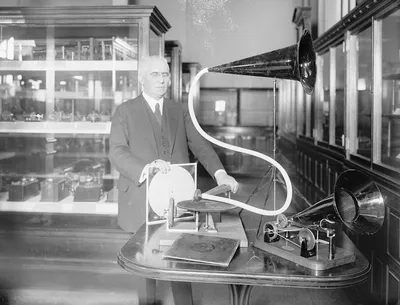
Born in Hannover in 1851, Emil Berliner moved to the United States in 1870. He would die in Washington D.C. in 1929. Between those two dates, he quietly reshaped how we hear technology.
He arrived just as Alexander Graham Bell had invented the telephone. Berliner didn’t just improve it. He reinvented the way sound moved through the device. In 1877, he built a transmitter using a loose metal contact. It was simple. It worked better than what existed. While testing this setup, he realized the device could also serve as a superior receiver. It captured sound with greater clarity. This wasn’t a minor tweak. It was a fundamental shift in acoustic physics.
How the Flat Record Changed Music
Berliner kept adding to the telephone infrastructure. But his mind drifted elsewhere. By 1887, he focused on a different problem: recording sound.
Thomas Edison had already created the phonograph. It used cylinders. The needle moved up and down. Gravity pulled on the stylus. This caused distortion. The sound was muddy. It wasn’t precise.
Berliner looked at that setup and saw flaws. He invented the flat disc. The record. The stylus moved horizontally across the surface. Not vertically. This eliminated the gravitational interference. The sound was cleaner. The distortion minimized.
He also figured out how to mass-produce these discs. Before this, recordings were unique artifacts. Now, they could be manufactured. This invention laid the groundwork for the entire music industry as we know it. Without the flat disc, there is no vinyl. There is no standard album format.
Beyond Audio: Engines and Acoustics
His interests didn’t stop at audio. He looked at the sky. In 1908, he designed a lightweight internal-combustion engine. It became a prototype. Other engineers copied it. It powered early aircraft. The design was efficient. It was widely imitated.
Family matters played a role in his later years. His son, Henry Berliner, designed a helicopter under Emil’s general supervision. The machine flew successfully in 1919. Early aviation. Experimental. But it worked.
He returned to sound one last time. In 1925, he invented an acoustic tile. These were designed for auditoriums and concert halls. They managed echo. They clarified space.
Berliner’s story isn’t just about one invention. It is about a man who saw inefficiencies in established systems and flattened them. The telephone. The record. The engine. The tile. Each solution addressed a physical limitation. Gravity. Friction. Distortion. He solved them with simplicity.
We still use his disc format. We still listen to the clarity he prioritized. The technology feels ancient now. It wasn’t always this way. It was new. It was radical. And it changed everything.