
An inductor is about as simple as an electronic component gets. Take a length of wire. Wrap it into a coil. That is it. But do not let the simplicity fool you. That coil of wire does some very interesting things. It relies on magnetic properties to control electricity. This article explains exactly what inductors are and why they matter in your devices.
Understanding Inductor Basics
The core concept here is magnetic fields. When current flows through a wire, it creates a magnetic field. Wrapping the wire into a coil concentrates that field. The more loops you add, the stronger the effect. This is not just theory. It is the foundation of how many circuits function.
Think about what happens when you try to change the current. The inductor fights back. It resists changes in current flow. This property is called inductance. It stores energy in the magnetic field. Then it releases that energy when needed. This behavior makes inductors essential for filtering signals. It also makes them key for powering devices.
You might wonder why we use coils instead of just wires. The answer lies in efficiency. Coils allow for compact designs. They save space in modern electronics. This is why you will find them in everything from smartphones to electric cars.
Inductors resist changes in current flow by storing energy in a magnetic field.
This resistance is not a bug. It is a feature. Engineers use it to smooth out power supplies. They use it to block high-frequency noise. They use it to tune radio frequencies. Without inductors, many of our digital tools would not work. The next sections will dive deeper into how these components are used.

Why Your Streetlight Knows a Car Is Waiting
You are likely walking down a sidewalk or sitting in traffic when you notice the light switch from red to green. That wasn’t magic. It was physics. Specifically, the behavior of an inductor.
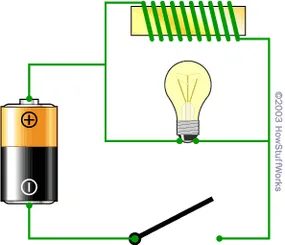
We often talk about resistors and capacitors, but the inductor is the quiet workhorse of circuit design. To see it in action, you don’t need a lab. You just need a battery, a light bulb, a switch, and a coil of wire wrapped around an iron core. That coil? That is the inductor.
If you removed that coil, you’d have a standard flashlight. Flip the switch. Light comes on. Simple. But leave the coil in there, and the behavior gets weird.
The Bulb That Flickers and Flashes
When you close the switch in this specific circuit, the bulb doesn’t just glow. It flares brightly, then dims out.
Logic suggests this shouldn’t happen. The bulb is a resistor. The wire in the coil is just copper—it has very low resistance. Current should bypass the bulb and flow through the coil, leaving the bulb dim or dark.
Instead, the bulb burns hot and bright initially. Then it fades.
Open the switch, and the reverse happens. The bulb flares up brightly again before quickly dying.
This isn’t a glitch. It’s the inductor doing exactly what it’s designed to do: store energy in a magnetic field and resist changes in current.
Think about water. Imagine a narrow channel with a heavy water wheel submerged in it. The water is still. You try to push water through the channel. The wheel resists. It takes time for the water to get the wheel spinning. Once it’s moving, the water flows freely.
Now, try to stop the water. The spinning wheel doesn’t stop instantly. It forces the water to keep moving for a few seconds, slowing down gradually.
An inductor does the same thing with electrons. It resists the start of flow. It resists the stop of flow.
How Inductance Is Measured
The strength of this resistance is called inductance. It is measured in henries.
What makes an inductor stronger? Four things:
- Number of coils : More loops mean more inductance.
- Core material : Iron cores massively increase inductance compared to air.
- Cross-sectional area : A wider coil holds more field.
- Length : A shorter, tighter coil increases inductance.
The formula for calculating henries is complex, involving pi, the number of turns, the coil’s area, and the core’s permeability (mu). Air has a permeability of 1. Steel can be 2,000. That’s why putting iron inside the coil makes a huge difference.
Detecting Cars with Magnetic Fields
This property allows us to detect objects. Take a coil of wire, maybe six feet in diameter, with five or six loops. Bury it in a groove in the road. Connect it to an inductance meter.
The meter reads a baseline value.
Now, park a car over the coil. The steel body of the car enters the magnetic field. It acts like a new core. The inductance spikes.
The sensor notices the change. It knows a car is there. The traffic light cycles to green.
This is how loop detectors work. They use the inductor’s sensitivity to magnetic fields to identify heavy metal objects. Without this, intersections would run on timers, not traffic.
Building Oscillators
Inductors aren’t just for detection. They are essential for creating oscillators. When teamed up with capacitors, they form circuits that generate stable frequencies. These are the heartbeat of radios, clocks, and signal generators.
Understanding the inductor explains why circuits behave the way they do. It explains why a light bulb might flicker when you flip a switch. It explains how a traffic light knows you are waiting.
It is a simple coil of wire. But it holds energy. It resists change. And it shapes the electrical world around us.