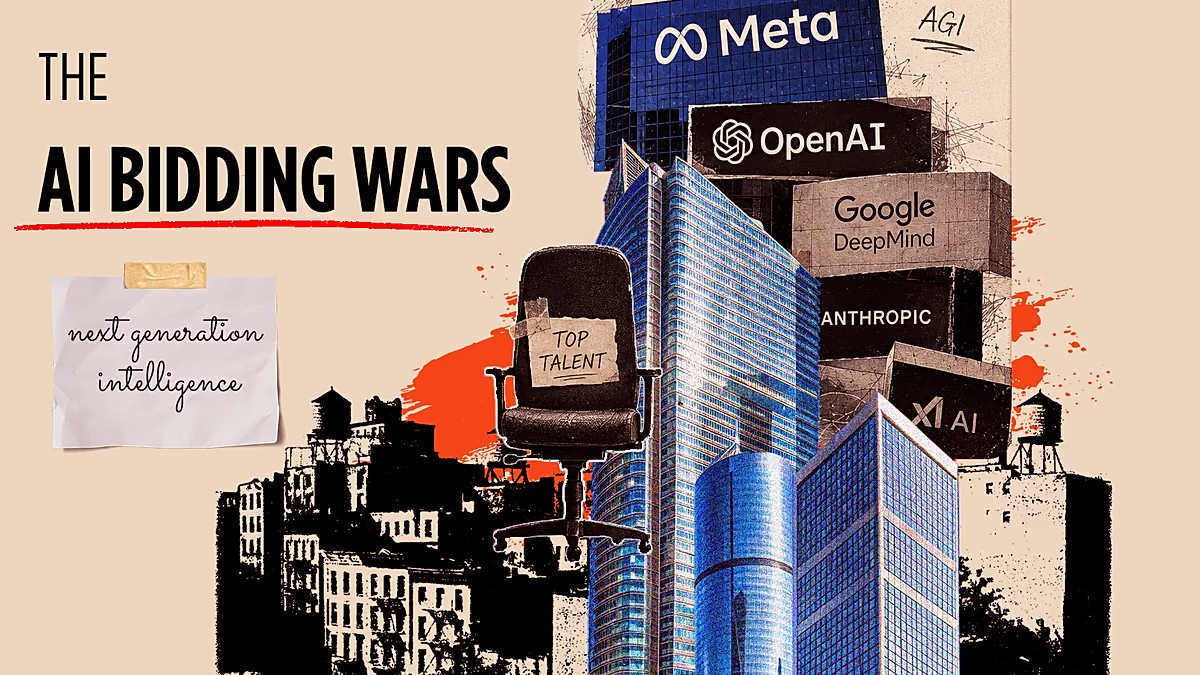
The AI industry isn’t just building models. It’s burning money. Specifically, on people.
There are only a few hundred humans on the planet who can actually build frontier AI at scale. OpenAI, Meta, DeepMind, Anthropic… they are all screaming into the void, trying to grab the same handful of engineers. It feels like the dot-com boom but with tighter margins and bigger egos.
In two years we’ve seen nine-figure offers. Equity grants that could fund small countries. CEOs like Sam Altman and Mark Zuckerberg doing personal headhunts because recruiters don’t understand the stakes.
Most internet gossip is noise. Unverified. Loud. We are skipping the rumors. Instead we’re looking at the five names where the bidding war is documented. Where major publications or the people involved have confirmed the drama.
They aren’t ranked. They just are.
Ilya Sutskever
The guy has gravity. Ilya Sutskever commands respect that few in computer science do.
As a co-founder of OpenAI he helped architect the GPT revolution. Before that? Google Brain. He was there when deep learning stopped being a academic curiosity and started being a threat to human redundancy.
Then the 2023 OpenAI coup happened. Altman got kicked out. Ilya stayed quiet for a bit then left to build Safe Superintelligence (SSI).
SSI is wild. No commercial product. Zero revenue. Yet in 2025 it is privately valued at $32 billion.
“We are building systems that think before they speak.”
Meta tried to buy it. Zuckerberg personally pushed for recruiting talent linked to the startup. It didn’t stick.
Last week Sutskever dropped a bombshell in court during the Musk vs OpenAI trial. He confirmed a $7 billion stake in the old company. He is a billionaire. Greg Brockman, his former colleague, is worth nearly $30 billion. The wealth distribution in AI is getting obscene.
Sutskever sells something rare: scientific credibility combined with execution. Investors believe he is one of the only people capable of actually reaching AGI.
Mira Murati
She was the face. Mira Murati ran the tech at OpenAI until 2024.
She oversaw ChatGPT. DALL-E. GPT-4. The things that broke the internet. Before Silicon Valley she was a senior product manager at Tesla, so she knows hardware-adjacent pressures too.
After quitting OpenAI she launched Thinking Machines Lab. It sucked up former OpenAI staff instantly. Like a black hole for talent.
Like SSI it has no product yet. Valuation? Over $5 billion. The focus isn’t autonomous AI gods. It’s collaboration. Human and machine working together.
They previewed “interaction models” recently. Voice controlled. Screen native. Supposedly seamless. We will see if it crashes on day one.
Meta tried to raid Thinking Machines too. It failed. Why? Because Murati has “recruiting gravity.” She can pull top-tier researchers just by existing. In an industry starving for talent that pull is a weapon.
Alexandr Wang
Not an academic. Not a pure theorist. Alexandr Wang built infrastructure.
He started Scale AI in 2016. Boring stuff? Maybe. Data labeling. Evaluation. The unsexy pipes that let LLMs actually work. But it worked so well that Scale became embedded in government and enterprise workflows.
In 2025 Meta bought a 49% stake. The price? $14.3 billion. That values Scale AI at $29 billion.
Wang joined Meta Superintelligence Labs as a leader.
Rumors suggest his comp package is historic. $1 million base. Millions in bonuses. $100-150 million in equity over five years. It might be real. It might not. But the signal is clear: Zuckerberg paid up.
Meta was losing the culture war to OpenAI. They needed Wang’s operational brain. He knows how to scale. He knows datasets. He knows that a model is only as good as the pipeline feeding it.
Knowledge of how to manage chaos is worth billions.
Demis Hassabis
He won a Nobel Prize. Then he went to work in tech.
Demis Hassabis founded DeepMind in London. They beat the world at Go. They solved protein folding. That 50-year-old biology problem? Solved.
Google bought DeepMind in 2014. The price was likely $500 million range. A steal. Back then AI was a hobby project.
Now? Hassabis is CEO of Google DeepMind.
After ChatGPT scared everyone, Google consolidated its AI efforts under him. The arms race is on. DeepMind fights Anthropic. It fights Meta. It fights OpenAI.
His pay? Disclosed in fragments. A $3 million bonus for Gemini. Estimated net worth of $600 million.
Hassabis holds a unique trinity: founder mindset. Elite science cred. Big corp leadership.
Keeping him happy is Google’s insurance policy. If he leaves the whole division shakes.
Andrej Karpathy
The influencer engineer. Andrej Karpathy co-founded OpenAI too.
He left early to go to Tesla. Led the AI team for autonomous driving from 2017. Neural nets for cars. Intense pressure.
He left Tesla. Briefly returned to OpenAI. Then in 2024 he started Eureka Labs.
Eureka is different. It focuses on education. On shaping how developers think. No massive private valuation yet.
But his net worth? Between $50 million and $150 million from past ventures.
He doesn’t need nine-figure paychecks to have power. He shapes the community. He influences engineering culture. When Karpathy speaks engineers listen.
Is that valuable?
Try finding someone else who can teach a room full of seniors why their loss function is broken. You won’t find another.