
If you are scrolling through social media during the day to decompress, you are likely on Twitter. It remains the go-to platform for active users seeking a quick mental break from the daily grind. Sure, the timeline can get frustrating. You will encounter tweets that annoy you. Anger is part of the ecosystem. But the site’s defining characteristic is its humor. It is the place where internet wit turns into global headlines. We often laugh harder than we mean to.
That is why we gathered the best content. We looked back at the archive. We selected specific posts that made people click “laugh” or “share.” Here are the en komik 15 tweet’i (15 funniest tweets) that defined the platform’s comedic side.
Why Twitter Dominates Internet Humor
The architecture of Twitter favors brevity. The character limit forces wit. It strips away the fluff. You do not have time for long setups. You need a punchline immediately. This constraint creates a unique style of comedy. It rewards quick thinking. It punishes over-explanation.
Users come for the news. They stay for the jokes. The social media landscape is crowded. Instagram favors aesthetics. TikTok favors performance. Twitter favors text-based irony. It is where the conversation happens in real-time. And where the funniest observations are posted first.
The Selection Criteria
We did not just pick random posts. We looked for consistency. We looked for relatability. A good joke lands because it feels true. These 15 tweets met that standard. They range from observational comedy to absurdity. They represent the peak of user-generated content.
What Makes a Tweet Go Viral?
Understanding the algorithm helps explain why these specific posts matter. Virality on Twitter is not random. It relies on engagement. A high retweet count signals relevance. A high reply count signals debate. But laughter? That signals connection. When you laugh, you are participating. You are validating the creator.
The most successful humor on the platform does not rely on shock value. It relies on perspective. It shifts how you see a mundane moment. That is the power of the medium. It turns the ordinary into content.
How to Find More Funny Content
You can curate your own feed. Follow accounts that prioritize comedy. Use search filters. Look for keywords like “relatable” or “funny.” The algorithm learns from your interactions. If you click on humor, it serves more humor. It is a self-reinforcing loop.
But be careful. The line between funny and annoying is thin. Tone is everything. A joke can miss. It can come across as aggressive. Context matters. The 15 tweets we selected navigate this line carefully. They are sharp without being cruel. They are funny without being mean-spirited.
The Impact of Digital Laughter
Laughter is a social glue. On Twitter, it creates temporary communities. Strangers bond over a shared joke. It breaks down barriers. In a polarized world, humor is a unifying force. It allows us to agree on something. Even if it is just the absurdity of daily life.
These posts remind us that internet culture is human. It is messy
The Hustle Culture Loophole
There is a specific flavor of irony in the modern wealth game. It involves teaching people how to get rich by charging them for the privilege.
We’ve all seen the pattern. A figure stands on a stage—or behind a premium webcam—and breaks down their success stories. The audience? Students. People trying to break into the market. They pay up. The speaker walks away with more money. The audience walks away with notes and perhaps a delusion of grandeur.
It’s a brilliant, if cynical, economic loop.
Monetizing Ambition
The tweet in question captures this absurdity with blunt force. The logic is simple: you teach the “how” to those who don’t know it. They pay for the “how.” You have now extracted value from their desire. You are richer. They are, theoretically, educated.
“Rich people explain how they got rich in paid seminars to poor people and students, and then get rich again. Good trap, huh.”
This isn’t just about grifting. It’s about information asymmetry. Most people want to believe there is a secret formula. It’s usually not a formula. It’s timing, leverage, and often luck. But packaging that ambiguity into a structured course feels like a product.
The Psychology of the Paywall
Why does this persist? Because hope is expensive.
When you’re staring at a bank account that doesn’t match your effort, the idea that someone else has the map is seductive. You don’t buy the seminar for the facts. You buy it for the promise that the path is shorter than you thought.
The “trap” mentioned in the tweet isn’t malicious by default. It’s a market correction. If no one bought these seminars, the industry would vanish. The fact that it thrives says less about the quality of the advice and more about the desperation of the advice-seeker.
Is It Worth It?
Some of these seminars contain genuine, high-value advice. Networking. Mindset shifts. Technical skills.
But the meta-game is always the same. The instructor’s greatest skill is often marketing themselves, not the subject matter they’re teaching. If you can sell the dream, you win. If you can learn to sell the dream, you might win too.
It leaves you wondering: who is actually teaching whom?

The internet has always loved to roast professions. Doctors, plumbers, and accountants get their due. But if you scroll through Turkish Twitter, there is one category that dominates the joke book: law students.
It isn’t just hate. It’s a specific kind of affectionate mockery that points to the absurdity of the legal education system.
One tweet went viral for being painfully accurate. It captures the essence of a first-year law student better than any textbook ever could.
Hukukçu biri: Yolda giderken araba çarpar. Şoför: Beyefendi iyi misiniz? Ambulans çağırayım mı? Hukukçu biri: Merak etmeyin iyiyim, Hukuk okuyorum bu arada.
Here is what happened in the story. A law student gets hit by a car on the street. The driver stops, panicked. He asks if the victim is okay. He offers to call an ambulance.
The student’s response is the punchline.
He says he is fine. He explains he is studying law.
The joke relies on a cultural truth. Law school in Turkey is notoriously difficult. It is a four-year grind of dense theory, endless reading, and a system that feels designed to break people.
If you can survive law school without dying, you can survive anything.
The driver assumes physical injury. The student implies academic injury is the only thing that matters. It is dark humor. It is relatable. It is why it spread.
Students see themselves in that tweet. They remember the nights spent memorizing articles. They remember the feeling of being crushed by the weight of the curriculum.
It is not about being broken. It is about endurance.
Other jokes follow the same pattern. One says a law student walks into a store. The cashier asks if they want a receipt. The student starts a debate about consumer rights.
Another says a law student goes to a wedding. The guest asks what they do. The student lists every article from the civil code relevant to marriage.
These are exaggerations. They are stereotypes. But they exist for a reason.
The legal profession is serious. The public sees lawyers as intimidating figures. Law students are seen as even worse. They are the training ground.
But inside the university, the mood is different. It is shared suffering.
When students share these jokes, they are bonding. They are saying “I am still here.” They are acknowledging the pain.
The viral tweet works because it is concise. There is no setup. No long explanation. Just a car crash and a punchline.
It is efficient. Like the law itself.
Non-lawyers might not get it. They see a man hit by a car. They see a strange response. They think the student is crazy.
Law students know the truth. The response is a defense mechanism. It is a way to laugh at the fear of failing.
The tweet also highlights the isolation of the degree. You are alone in the library. You are alone with the books. You are alone when the car hits you.
Your major is your entire identity.
This is why the meme lasts. It is not just a funny story. It is a testament to resilience.
So next time you see a law student walking down

It is a modern parenting paradox. You spend all day saying “yes.”
You override every rule the mother has set. No ice cream until after dinner? Forgotten. Chocolate for breakfast? Done. You are the fun parent. The indulgent one. The one who buys the extra toy.
Then, you go home. You try to teach a lesson about loyalty.
It backfires. Spectacularly.
This is not just a funny tweet. It is a cautionary tale about co-parenting dynamics and the unintended consequences of undermining your partner’s authority. And it ends with a piece of advice that might be too broad to be useful, but perfectly captures the frustration.
The Setup: Total Surrender to Sweet Tooths
The scenario starts innocently enough. From morning until night, the dad decides to ignore the mom’s dietary rules.
We are talking about the small stuff. The stuff that adds up.
- Ice cream
- Chocolate
- Anything else the mother said “no” to
He feeds her everything. Every request. Every craving. He does not hesitate. He does not check in with the mom. He just says yes.
Why? Maybe he is trying to bond. Maybe he thinks he is being generous. Maybe he is tired.
The result? The daughter clings to him. She kisses him. She hugs him. She calls him “Baba” (Dad) repeatedly. She sees him as the hero. The provider. The nice guy.
It feels good. For a moment.
The Trap: A Lesson in Loyalty
Evening comes. They are back home.
The dad decides it is time to correct the course. He wants to remind his daughter who really matters. Who holds the real power. Who she should trust more.
He asks a loaded question.
“Sen kimin kızısın?” (Whose daughter are you?)
It is a trick question. Or so he thinks.
He expects a shout-out to him. The fun dad. The one who gave her all the chocolate.
She responds instantly.
“I am the daughter of my beautiful mother.” (Güzel anneciğimin kızıyım)
There it is. The punchline.
The Lesson: Trust Issues Are Real
The dad’s conclusion is blunt.
“Kadınlara güvenmeyin.” (Do not trust women.)
Is it funny? Yes.
Is it accurate? Debatable.
Is it a warning for other dads? Absolutely.
Here is what actually happened. The dad tried to create a false dichotomy. He thought by being the “bad cop” in reverse (the “fun cop”), he could win the loyalty battle. He assumed that indulgence equals affection.
He was wrong.
The daughter’s response reveals something important. She knows the rules. She knows who sets the structure. She might enjoy the treats, but she identifies with the mother. The mother is the constant. The father was a temporary source of sugar.
Why This Matters for Parents Everywhere
This tweet went viral because it hits a nerve. Every parent has faced the “fun parent” trap.
- Undermining Authority: When one parent ignores the other’s rules, it creates confusion for the child. It also creates

The Anatomy of a Digital Self-Sabotage
It’s a specific brand of humiliation that only exists because we carry our entire social history in our pockets. You aren’t just making a typo. You are accidentally handing someone the ammunition that destroys your reputation in their private circle.
The scenario is deceptively simple. You are arguing with a guy. Or maybe flirting. Maybe just venting. Whatever the context, you take a screenshot of his messages. Your intent is pure archival violence: you want to show the girls in your group chat what he said. It’s for validation. It’s for the side-eye. It’s for the collective judgment.
But your thumb slips.
Instead of tapping the share icon and selecting the group, you tap your own conversation thread. The images load. They appear. And then the realization hits like a cold splash of water.
He sees the notification. He sees the three dots. He sees the screenshots.
The Silence Before the Storm
His response is usually minimal. A single question mark. ?
It’s terrifyingly efficient. He knows. He doesn’t need to spell it out. The digital trail is too fresh to deny. If you try to explain, you dig the grave deeper. If you delete the messages on your end, you know he still has his copy. You know the group chat already received the proof.
So what do you do?
You panic. You scramble for a narrative that doesn’t make you look like a stalker. And then, in a move of pure desperation, you deploy the oldest trick in the book. You claim you meant to look at the conversation from his perspective.
“I wanted to see it from your point of view,” you type.
Why This Excuse Fails Spectacularly
It’s a weak defense. A desperate lie wrapped in pseudo-psychological insight. No one buys it. The girls in the group chat aren’t stupid. They know the difference between “empathy” and “evidence collection.”
This isn’t just about one argument. It’s about the erosion of trust in digital communication. We’ve created an environment where private conversations are public property by accident. The barrier between “private” and “public” is just a user interface choice. And interfaces fail.
The aftermath is always the same. The group chat goes quiet. The memes stop. The shared inside jokes become awkward. You are now the girl who couldn’t manage her own clipboard. You are the gossip who became the gossip’s subject.
The Broader Implication of Digital Fragility
This incident highlights a critical flaw in how we handle intimate or confrontational text exchanges. We assume the medium is secure. We assume that the recipient of a screenshot doesn’t have the same access. We forget that in the age of smartphones, every device is a potential broadcaster.
There is no undo button for social capital. Once that screenshot is in the group, it propagates. It’s copied. It’s forwarded. It’s remembered. The boy in the conversation doesn’t even have to respond aggressively. His silence is often louder than any insult. It allows the image of you—desperate, insecure, screenshotting—to speak for itself.
We need to be more careful. Not just with our words, but with our intent. Before you hit that command-key combination, ask yourself why you need proof. Do you

When Family Obligations Clash With the Big Match
You know that moment when your entire social calendar hinges on a ninety-minute football match, but then reality crashes in with a wedding invitation? That’s exactly where this dad finds himself.
The scenario is simple, yet devastatingly specific. It’s Saturday. It’s derby day. The tension is high, the stakes are higher, and the television is already tuned in. But wait. His cousin’s wedding is happening at the exact same time.
Now, the dad isn’t asking for advice on whether to go or stay. He’s not debating the merits of family loyalty versus football passion. He’s asking something far more bureaucratic, and infinitely more hilarious.
“Did they officially invite me?”
Not “Can I get out of this?” Not “Is there a good excuse?” Just a flat, direct question about the protocol. Did he receive a clear, unambiguous summons? If the invitation wasn’t explicit, does that mean he’s off the hook?
“Be absolutely clear and direct: Was I officially invited?”
It’s a clever loophole. He’s treating a family event like a corporate meeting. If the deliverables—specifically, the direct invitation—aren’t met, he’s legally allowed to stay home and watch the match.
The humor lies in the specificity. He’s not being rude. He’s not being lazy. He’s just holding them to the letter of the law. If the cousin didn’t call, didn’t text, didn’t hand him a physical card with the time and place, then technically, he’s free.
This isn’t just about football. It’s about the universal truth of adult men finding the most ridiculous, technical ways to avoid responsibilities they secretly dread. The dad isn’t fighting for his life; he’s fighting for a loophole. And frankly, if the invitation wasn’t airtight, who are we to judge?
The real question isn’t whether he should go. The real question is whether the cousin was sloppy enough to leave him an out. If they were, he’s watching the derby. If they weren’t… well, he’ll probably find a way to make it work. But he’ll definitely complain the entire time.

The Algorithmic Matchmaker vs. İbrahim Tatlıses
The internet is currently treating İbrahim Tatlıses, the legendary Turkish arabesque singer, not just as a musical icon, but as a dataset for social commentary. In a move that blends high-brow statistical jargon with the melancholy of modern dating, a user took to Twitter to analyze the singer’s discography through the lens of personal failure.
The tweet in question is a masterclass in absurdity. It asks followers to evaluate the “positive correlation” between two very specific scenarios:
- The Literal Struggle: Trying to find a stone in the Dere (stream/valley) while going down—implying a futile, physical effort in a natural setting.
- The Romantic Struggle: The user’s own inability to find a suitable partner (“kendime göre eş bulamama”).
“So, how do you evaluate the positive correlation between my inability to find a stone in the valley while going down and my own formation of being unable to find a spouse?”
Why This Tweet Went Viral
This isn’t just a random joke. It taps into a broader trend of using Turkish internet slang and academic terminology to describe existential dread. The humor comes from the juxtaposition. You have İbrahim Tatlıses, a figure associated with heavy emotion, heartbreak, and traditional values, paired with cold, clinical language like “positive correlation” and “formation.”
The tweet implies that just as nature refuses to give up a simple stone in a rocky stream, life refuses to give up a compatible partner. It’s a self-deprecating take on modern dating fatigue. The user isn’t just saying “I’m single.” They are framing their loneliness as a statistically significant event tied to the cultural memory of a national singer.
İbrahim Tatlıses as a Cultural Reference Point
To understand why this specific lyric or sentiment resonates, you have to look at İbrahim Tatlıses’s impact on Turkish culture. His music often deals with themes of loss, wandering, and longing. The reference to “dere” (valley/stream) and “taş” (stone) evokes images of isolation and the difficulty of finding something solid in a chaotic world.
When internet users remix these themes with data science terms, they are creating a new form of social satire. It allows people to discuss their personal failures—like being single or failing at simple tasks—without sounding too vulnerable. By wrapping their pain in a tweet about “correlations,” they create distance. They aren’t sad; they are analyzing their sadness.
The Broader Trend of “Academic” Memes
This tweet is part of a larger phenomenon where Turkish social media users adopt pseudo-intellectual language to describe mundane or tragic life events. You’ll see similar posts discussing the “statistical probability” of getting fired, or the “linear regression” of aging.
It’s a way of coping. If you can label your breakup as a “market correction,” it hurts less. If you can describe your inability to find love as a “positive correlation” with a İbrahim Tatlıses lyric, you’re part of a club. You’re not alone in your failure; you’re statistically aligned with a cultural icon.
How Users Are Responding
The responses to this tweet

The Algorithmic Echo Chamber of Grief
It starts with a single data point. One tweet, posted by a user who found solace in the turbulent voice of Ahmet Kaya. The logic is simple, almost primitive: if your morale is low, check the artist’s. If their mood feels worse than yours, you feel better by comparison. It’s a relative happiness metric, derived from the shared cultural memory of a singer known for his defiance and despair.
This isn’t just nostalgia. It’s behavioral data.
When a user interacts with content this way—liking, sharing, or quoting a post about listening to Kaya to cope—they are tagging themselves. The algorithm doesn’t care about the political weight of Kaya’s lyrics or the tragedy of his exile. It cares about the engagement. It sees a spike in time-spent-on-page. It sees a connection formed between “low mood” and “Anatolian rock.”
Why This Specific Reference Matters
Ahmet Kaya isn’t just a singer in this context. He is a specific signal in the noise. For Turkish diaspora communities, or anyone familiar with 90s Turkish music, Kaya represents a certain kind of intellectual and emotional intensity. He is difficult. He is controversial. He is real.
When an algorithm learns that a user responds positively to Kaya-themed motivational content, it stops showing them generic self-help quotes. It starts curating a feed that reflects that specific intensity. You get darker music. You get comments on social isolation. You get content that validates the feeling that the world is against you, but that you can endure it because others have endured worse.
The tweet—“I listen to Ahmet Kaya when my morale drops. The reason is that his morale seems worse than mine” —is a perfect example of negative comparison as a coping mechanism. It’s relatable. It’s funny. It’s sad. Algorithms thrive on that triad.
How the Feed Adapts
Once that tweet is in the data stream, the recommendation engine begins to map adjacent interests.
- Musical Adjacency: If you liked the Kaya tweet, you might get recommended other Turkish rock bands with melancholic themes. Not the pop stuff. The gritty stuff.
- Lyrical Analysis: You might see threads dissecting Kaya’s lyrics for hidden meanings of resistance. The algorithm knows that users who engage with Kaya also engage with meaning, not just melody.
- Political Framing: Kaya was banned by the Turkish state. The algorithm may subtly push content related to censorship, exile, or political dissent, assuming the user identifies with the struggle inherent in Kaya’s biography.
This is where it gets interesting. The user isn’t searching for “political news.” They are searching for “morale boost.” But the algorithm has learned that for this user, morale is boosted by solidarity in suffering. It’s a dark loop.
The Danger of Personalized Empathy
The risk here isn’t that you’re getting bad advice. It’s that you’re getting echoed pain.
If the algorithm only shows you content that reinforces the idea that “life is hard, but we are tough,” it narrows your world. It creates a filter bubble of resilience that doesn’t account for joy, ease, or different kinds of hope

The Art of the Self-Deprecating Roast
It’s a specific brand of humor that lives in the spaces between self-loathing and charm. You know the type. It’s not just complaining. It’s curating your own flaws for public consumption.
Take the tweet shared by a user who decided to break down their similarities with Turkish pop icon Kenan Doğulu. The comparison is… interesting. On one side, you have a massive celebrity known for his voice and his looks. On the other, an anonymous user listing three very human failures.
The tweet was simple. Direct. Brutal.
“Listing my common traits with Kenan Doğulu:
– Can’t keep time.
– Don’t understand beauty.
– Never get asked.”
Why This Specific Comparison Lands
Kenan Doğulu is a figure of high aesthetic standards and musical precision. Or at least, that’s the public persona. The user’s list inverts those virtues.
First, time management. This is a universal struggle. Everyone misses meetings. Everyone is late. It’s relatable because it’s true. But linking it to a star implies that even the “perfect”偶像 struggles with basic logistics. Or maybe the user is just using the name for the shock value of the association.
Second, appreciating beauty. This is the punchline. Kenan is famously good-looking. The user claims to have no taste in aesthetics. It’s a humble-brag disguised as insecurity. It says, “I am not like him,” while simultaneously drawing attention to himself by naming him.
Third, and the hardest hit: being asked. This refers to invitations. To dates. To the party. The user says no one asks him. Kenan gets asked everywhere. It’s a sharp commentary on social visibility. It’s the difference between being a guest and being a host. Between being invisible and being the main event.
The Mechanics of Viral Self-Roasts
Why do tweets like this get engagement? They aren’t clever wordplay. They aren’t satirical. They are raw.
- Specificity : Naming a real person anchors the joke. If it were “a famous singer,” it would be weak. Kenan provides instant context for a specific demographic.
- The Underdog Narrative : We love watching people tear themselves down. It feels safe. It feels honest.
- Ambiguity : Is the user joking? Are they serious? The tone is flat. That lack of emotional signaling allows readers to project their own feelings onto the text.
This isn’t just about Kenan. It’s about the modern need to perform vulnerability. We don’t just say “I’m lonely.” We say “I have the same flaws as a mega-star, but worse.” It dramatizes the ordinary.
The tweet went viral not because of Kenan. It went viral because the last line is a quiet scream that half the internet recognizes. Being overlooked. Being uninvited. The ability to turn that pain into a punchline is the real skill here. And maybe, just maybe, that’s the only thing the user and Kenan actually share.

The LinkedIn Paradox: Sharing the Mundane
We’ve all been there. You’re scrolling, and suddenly you’re hit with a post that feels less like professional networking and more like a personal diary entry. The caption usually follows a specific rhythm: “My friend recently bought a car. They forgot they had a car after work and took the bus home.”
It sounds harmless. Maybe even relatable. But look closer. This is the peak of modern social media absurdity. It’s not about the car. It’s not about the transportation mix-up. It’s about the desperate need to manufacture connection in a space designed for transactional value.
Why We Post the Boring Stuff
Think about the mechanics of this tweet. It’s a story with a setup and a punchline, but the stakes are nonexistent. The “friend” isn’t a colleague. The “car” isn’t a company vehicle. The “bus” is just public transit.
Why does this work on platforms like Twitter or LinkedIn? Because it’s safe. It’s a low-risk way to signal personality without actually risking professional reputation. It’s the digital equivalent of wearing a novelty socks. You’re showing a tiny sliver of humanity in a space that demands polished armor.
“It’s not about the car. It’s not about the transportation mix-up. It’s about the desperate need to manufacture connection.”
The Algorithm Loves “Relatability”
Platforms push content that stops the scroll. A dry update about quarterly earnings doesn’t stop the scroll. A story about forgetting your own car does. It triggers a micro-emotion: I’ve done that. Or I know someone who did that.
This is why these posts spread. They are designed for engagement, not information. The user who posted it isn’t trying to inform you about traffic patterns. They’re fishing for a “LOL” or a “Same!” comment. It’s a social hack. A way to hack the algorithm by pretending to be vulnerable.
The Disconnect Between Brand and Self
Here’s the weird part. The person posting this is often the same person who spent three hours curating a LinkedIn profile to look like a thought leader. They want to be seen as serious. Intelligent. Capable.
Yet, their feed is filled with stories about public transit errors. It’s a schizophrenic digital identity. One half wants to be hired. The other half just wants to be liked. And the algorithm, being the impartial beast it is, rewards the liked part.
So you keep seeing it. You keep scrolling. And you keep wondering why you care about a friend’s friend’s bus ride.

The “Kayserili” Meme: When Kindness Gets a Price Tag
There is a specific flavor of Turkish humor that lives in the space between aggression and absurdity. It doesn’t show up in stand-up clubs or polished sitcoms. It leaks in. It’s in the way a guy in a polyester suit talks to a vendor. It’s in the logic that feels slightly broken but somehow holds up under scrutiny.
One of the most durable formats for this energy is what people call the “Kayserili cimrilik” meme.
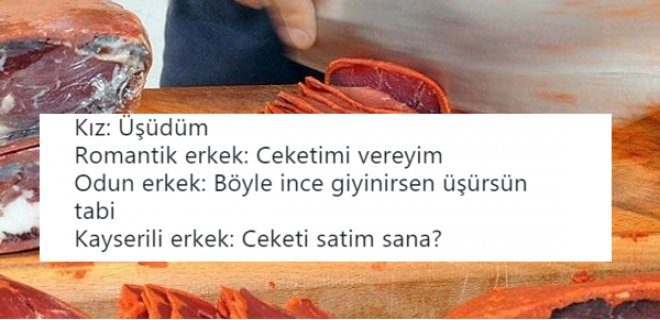
You see it on Instagram carousels. You see it in WhatsApp forwards that end up in your group chat at 2 AM. It’s usually structured as a simple three-part comparison. A female character states a basic human need. A “romantic” guy responds with expected chivalry. A “wooden” guy responds with judgment. And then a guy labeled as being from Kayseri responds with a financial transaction that makes zero emotional sense but perfect literal sense.
“I’m cold.”
Romantic guy: “Here, take my jacket.”
Wooden guy: “You’re dressed too lightly. Of course you’re cold.”
Kayserili guy: “Do you want to buy the jacket?”
It’s funny because it’s so anti-climactic. The romantic gesture is replaced by a sales pitch. The emotional connection is severed by a commercial one. But if you look closer at why this resonates, it’s not really about Kayseri. It’s about a cultural anxiety around value.
The Anatomy of the Joke
The meme relies on a stereotype that has been circulating in Turkish internet culture for years. Kayseri, a major industrial city in central Anatolia, is often caricatured as a place of hard-nosed traders. The stereotype paints locals as shrewd, practical, and relentlessly focused on the bottom line.
This isn’t entirely new. Turkey has a rich history of market culture. In the bazaar-style economies that dominate much of the country, haggling isn’t just a tactic; it’s a language. You don’t just buy an apple. You negotiate the terms of the apple. You discuss its origin, its sweetness, and its price. To someone from outside that culture, or someone who prefers modern retail pricing, that process can look aggressive. It can look like greed.
The meme takes that reality and pushes it to a breaking point.
When the romantic guy offers his jacket, he is offering himself. He is offering warmth. He is offering vulnerability. It’s a high-risk, high-reward social move.
When the Kayserili guy asks if you want to buy it, he is treating the jacket as a commodity. He is stripping away the romance and leaving only the asset.
The humor comes from the whiplash. You expect a continuation of the social script. Instead, you get a ledger.
Why “Kayserili”? Why Not “Istanbulli”?
You might wonder why the punchline isn’t assigned to Istanbul. Istanbul is the center of Turkey, the place of modernity, of cafes, of people who wear expensive coats and complain about the weather. An Istanbul guy might offer his jacket. Or he might judge your fashion choices. But he wouldn’t ask you to buy it.
The choice
Let’s talk about the specific brand of comedy that thrives in the shadow of personal collapse. It isn’t the safe, sanitized wit of a sitcom. It is raw. It is offensive. And for a certain demographic of internet users, it is hilarious.
The tweet in question doesn’t just describe a bad week. It describes a life unraveling in fast forward. The premise is simple but devastating. A friend has hit rock bottom so hard he has passed through it. He lost his gambling money. He cheated on his wife. She left him. He got fired for being an alcoholic.
“If hell didn’t exist, I would have committed suicide,” he says.
That is the setup. The punchline is delivered with cold precision.
“Since you’re already the superior devil, [hell] exists.”
The Architecture of Dark Comedy
Why does this work? Why do people share it? It taps into a very specific psychological trigger. We call it tragicomedy. Or maybe just morbid curiosity. The tweet uses hyperbole as a structural device. It takes a series of catastrophic failures and frames them as a prerequisite for a supernatural punishment.
The logic is twisted but internally consistent within the joke. If you are this bad, regular hell isn’t enough. You need the boss. The “superior devil.”
This isn’t just about being edgy. It’s about the absurdity of human suffering. By personifying the consequence as a personification of evil itself, the writer removes the religious weight and replaces it with a corporate one. Hell becomes a workplace. And the friend is the new manager.
The Role of the Platform
Twitter, or X, is the perfect vessel for this kind of content. It rewards brevity. It rewards impact. You have 280 characters to dismantle a narrative. There is no room for nuance here. The joke relies on the reader connecting the dots between gambling, infidelity, unemployment, and damnation.
The comment section becomes a battleground. Some see it as cruel. Others see it as the funniest thing they’ve read all day. This polarization is part of the engagement loop. The algorithm loves conflict. It loves outrage. It loves laughter at someone else’s expense.
Why It Resonates
There is a safety in watching others burn. We look at the friend’s situation and think, “At least I’m not him.” It’s a defense mechanism. We laugh to keep from crying. Or worse, to keep from realizing that one bad decision can lead to another.
The tweet is a mirror. Not a kind one. It reflects our own fears of failure. Of losing control. Of becoming someone so broken that even the devil has to step in and take notes.
Is it funny? Sure. If you have a dark sense of humor. If you can detach yourself from the real pain involved.
The next time you see a tweet like this, ask yourself what it says about you. Not the person who wrote it. You. The reader. The one clicking “Like.”

The “Run Away” Strategy for Splitting the Bill
Dating etiquette often comes down to unspoken rules that shift with every generation. The classic question remains: who pays on the first date? The conversation usually circles back to gender norms. Some argue for chivalry, where the man covers the tab. Others push for total equality, suggesting a split.
But there is a third option that defies all social contract. It’s not about splitting 50/50. It’s not about one person paying for the other. It’s about avoiding the transaction entirely.
The most humorous take on this dilemma suggests a radical avoidance strategy. The rule is simple: neither party pays.
“A man never pays for a woman, and a woman never pays for a man. They should hold hands and run away from the venue without paying.”
This response isn’t just a joke. It’s a commentary on the anxiety surrounding modern dating transactions. The idea of sitting at the table, waiting for the check, and navigating the awkward dance of “I got it” versus “No, I insist” can be exhausting. Some couples find the tension worse than the cost.
Choosing to flee is an extreme solution. It highlights how much pressure we put on small gestures. Does a missed payment matter if the connection was good? Or does the awkwardness of the bill destroy the mood before the night even ends?
For those who can afford the getaway, running away might be the ultimate power move. For most, it’s just a funny way to say the system is broken. You laugh because there’s no good answer.

The “2002 Model” Joke and Why It’s Actually Genius
It started with a simple, devastating question. Someone asked a kid for their birth year. The kid replied “2002.”
The response? Instant disbelief.
“Human beings don’t get born in 2002. At best, you’re a 2002 model sports car. Births stopped in the 90s.”
It’s a classic Gen Z roast. But if you look past the humor, it reveals something strange about how we perceive time and milestones.
Why 2002 Feels Like a Car Release, Not a Birth
For people born after 2000, their arrival feels less like a biological event and more like a tech product launch. The joke works because 2002 was peak Y2K cleanup era. We were obsessed with new models, new releases, and upgrades.
When someone says “2002 model,” they mean sleek. Efficient. Maybe a bit flawed, but definitely new.
Applying that to a human is insulting. It strips away the chaos of infancy. It turns a life into a specification sheet.
But here’s the kicker: Gen Zers own it. They laugh at the “sports car” label because, honestly, they are the first generation to grow up with smartphones as a baseline. Their “model year” is 2002. Or later.
The End of the “Old” Era
The tweet implies that the 1990s were the last true decade for “traditional” human development. Before that, you had dial-up. Before that, you had landlines.
Now? We’re in the age of instant feedback.
If you were born in 2002, you didn’t experience the slow grind of pre-internet socialization. You went straight to the cloud.
So when the older generation makes fun of your “model year,” they’re not just being mean. They’re confused. They don’t know how to categorize a human who thinks in memes and downloads.
And that’s why the joke lands. It’s not just a dig at your age. It’s a dig at your operating system.

Why Do American Backyards Have Empty Pools?
The internet has a funny way of highlighting cultural absurdities. A recent tweet about American TV shows captures a specific frustration that resonates with anyone who has watched too much procedural drama or suburban sitcoms. The observation is simple but stinging: characters in these series own backyard pools, yet the water stays crystal clear and empty for two full seasons.
“I’m watching a foreign series, guys have a pool in their yard, no one goes in it for 2 seasons. If I had a pool in my yard, I’d dive in even in winter wearing a coat.”
It’s a joke, sure. But it points to a deeper disconnect between the aesthetic of American leisure and the practical reality of maintaining one.
The Aesthetic vs. The Reality
In many US-based shows, the backyard pool is less of a functional space and more of a set piece. It’s there to signal wealth, suburban success, or a backdrop for a dramatic conversation. The water is rarely used for swimming. It’s a prop.
For viewers from cultures where outdoor living is dictated by climate and utility, this looks wasteful. In colder climates, a pool is a seasonal burden. You heat it, you skim it, you cover it. In warmer regions, it’s a place to cool off. But in TV land, the pool is a permanent, inviting rectangle of blue that never sees a body.
Why It Feels Illogical
The humor comes from the lack of consequences. If a real homeowner ignored a pool for months, algae would bloom. Chemicals would balance out. It would become a mosquito breeding ground. In the show, the water remains pristine because the script doesn’t require the characters to swim. They stand on the deck. They talk. The pool just sits there.
This highlights a common critique of American media: the prioritization of visual appeal over lived experience. The “perfect” backyard is better than the used backyard. It’s cleaner. It’s more static. It’s safer for the narrative.
The Viewer’s Reaction
The tweet resonates because it breaks the fourth wall of immersion. It reminds the viewer that they are watching a constructed reality. It’s the same kind of eye-rolling you do when a character drives a luxury car that never gets dirty, or eats a meal that is perfectly plated while discussing a crisis.
We’ve all been there. You’re watching a show, and suddenly you notice the absurdity of a pristine pool in a yard that clearly isn’t used for swimming. It’s not just about the pool. It’s about the gap between what we see and what we know.
Does it matter? Not really. The show will end. The pool will stay empty. But for a moment, you’re reminded that you’re watching a fantasy, not a documentary. And sometimes, that’s enough to make you laugh. Or sigh.

The Tweet That Fooled Everyone (But Not Quite)
He didn’t have a girlfriend. The tip was solid enough to get police boots on the ground, but the outcome was pure comedy. A young user took to Twitter to document the absurdity, leaning into the delusion with devastating accuracy.
“Men and women are living together,” the anonymous informant claimed.
The police didn’t ask for proof. They kicked down the door.
Now the officer was standing in the hallway, headset on, scanning the living room like it was a hostage situation. The narrative in the tweet was simple. Brutal.
“Memur beylerle beraber kızı arıyoruz şu an. İnşallah doğrudur ya ihbar.”
Translation: “We are looking for the girl with the officers right now. Hopefully, the tip was correct.”
The joke isn’t just that he’s single. It’s that he’s pretending to be in a relationship so thick with suspicion that law enforcement feels the need to raid the premises. He’s not just hopeful. He’s actively role-playing a domestic drama that doesn’t exist. The tipster was right about one thing, though. There was definitely a girl involved in the fantasy.
The tweet captures a very specific brand of modern loneliness. You don’t just want a partner. You want the consequences of having one. The raid. The confusion. The chaotic energy of a police lineup in your own kitchen.
It’s funny because it’s pathetic. It’s pathetic because it’s relatable. We’ve all wanted someone to look at us with that level of urgent concern. Even if it comes from a stranger who doesn’t know we don’t actually live with anyone.
The officer is still searching. The user is still typing. The reality is empty. The tweet is full.

The algorithm is a black box. You scroll, it serves. But if you are serious about keeping up with internet infrastructure, software development, and IT trends, you cannot rely on passive consumption. The noise is loud. The signal is weak.
You need curators. People who cut through the press releases and show you what actually breaks in production.
Here is a breakdown of channels that matter. Not the ones with millions of views for clicking mice fast, but the ones that teach you how the web works.
The Infrastructure Layer
Most people think “cloud.” They think AWS or Azure. They don’t think about the packets moving between them.
NetworkChuck does. He makes networking look like a video game. Is that fair? No. But it works. He explains BGP, OSPF, and VLANs without putting you to sleep. If you are an sysadmin or a devops engineer who has forgotten what a subnet mask actually does, start here. It is accessible. It is loud. It works.
For the deep dive into Linux, Linuxiac is quiet. It is not flashy. It shows you how to configure Nginx, how to manage users, and how to keep your server secure. It is the opposite of hype. It is documentation come to life.
When you need to understand the underlying hardware of the cloud, look at Server Side Show. It is a podcast, but the visual companion content on their channel is where the real value lies. They talk to the people building the tools you use every day. You learn why a specific database choice failed in production. You learn why consistency models matter more than speed in financial transactions.
The Developer Experience
Coding is no longer just about syntax. It is about tooling. It is about the environment your code lives in.
Fireship is the exception to the rule of “short attention spans.” His 100-second explanations of complex topics like Kubernetes, React, or Rust are surprisingly accurate. They are fast. They are dense. They do not waste time. If you have five minutes to understand what a new framework is before your stand-up meeting, this is where you go.
But speed is not depth. For that, you need Theo. He covers CSS, JavaScript, and accessibility. He does not just show you how to center a div. He explains why centering is hard and why the browser renders it that way. He cares about the user on the other side of the screen. In an era of bloated apps, caring about the pixel is radical.
Traversy Media is the grandfather of YouTube tutorials. Brad Traversy has been doing this since the Flash era. His full courses on Node.js, Python, or Go are still relevant because they focus on fundamentals. Not trends. Fundamentals. Trends change every six months. Fundamentals stay the same for decades.
The Security Reality
Security is not a feature. It is a constraint. And most tutorials ignore constraints.
IppSec is for the ethical hackers. The videos are long. They are detailed. He walks through entire HackTheBox machines. He does not just show you the exploit. He shows you the enumeration. The methodology. You learn to think like an attacker by watching him break into systems that are supposed