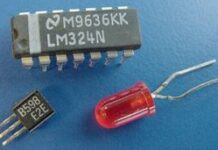
Every time you pick up the phone, you touch a transistor. You blink it on a computer screen. The Internet depends on millions of users to keep it running. But what exactly are they?
Think of the transistor as a very precise tap. It’s not just about turning traffic on or off. It controls how much water gets through. In the world of electricity, “water” is the flow of electrons. Transistors control this flow very precisely, allowing circuits to switch signals on and off or amplify them so they can travel further.
Without such control, modern electronic devices would not only be clunky, they would cease to exist at all.
The Accidental Timing of Silicon’s Predecessor
The invention of the transistor was not a random act of genius. It requires materials that can only be scientifically produced at certain moments in history.
The first transistors created at Bell Laboratories were made from germanium. Scientists know that pure germanium is an insulator and prevents the flow of electricity. However, it has been found that adding small impurities through a process called doping turned it into a weak conductor. This led to the birth of semiconductors.
Semiconductors are somewhere in between. They are not perfect conductors like copper, and they are not perfect insulators like glass. They can be tuned.
Why did this happen right after WWII? timing. The war effort spurred major advances in refining pure germanium and improving doping techniques. Suddenly, the raw materials needed to make transistors finally reached the required purity. Before this, these things did not exist in a usable form.
P-N Junctions: The One-Way Street of Electronics
Doping determines the behavior of semiconductors. Depending on which elements are added to germanium, one of the following can happen:
- N-Type: Additives add extra electrons. Because they are negatively charged, the material tries to push the electrons out.
- P-type: The dopant removes an electron and creates a “hole” where the electron used to be. This causes the material to become positively charged and attract electrons from nearby materials.
Placing an N-type layer next to a P-type layer creates a P-N diode.
This intersection has electric one-way traffic. Electricity flows easily in one direction, but is blocked in the other direction. This property is the basis of rectification, which converts alternating current (AC) to direct current (DC) and is the building block of all complex circuits.
From diodes to junction transistors
Diodes are useful, but transistors are also powerful. To achieve this, engineers layered these materials one after the other.
The end result is a P-N-P or N-P-N structure. The middle layer is called the base. The point where the layers intersect is called the junctions. Therefore, the original device is often called a junction transistor.
There is magic here. By directing a small current into this base layer, much larger currents can be directed through the rest of the device.
When a small current is applied to the base, the gate opens and electrons move from the N-type side to the P-type side. That little input acts as a switch. A large current can pass through it. When the input is stopped, the large current stops.
Because of this dual function, transistors are the backbone of computing. These act as logic gate switches (0 or 1, on or off). These act as amplifiers (amplifying weak signals) for radios, audio and sensors.
The Silicon Shift
For over 20 years, germanium transistors have been everywhere. These worked on early radios, computers and televisions.
However, germanium also has its drawbacks. It is sensitive to heat and harder to refine consistently. Eventually, the industry switched to silicon-based semiconductors. Silicon is abundant, inexpensive to handle and far more reliable under varying temperatures.
Few people currently use germanium to make new commercial electronics. But the principle is the same. The N-type and P-type layers still dance together, exchanging current and amplifying the signal. The material has changed. The physics didn’t.
We’ve moved from bulky germanium blocks to