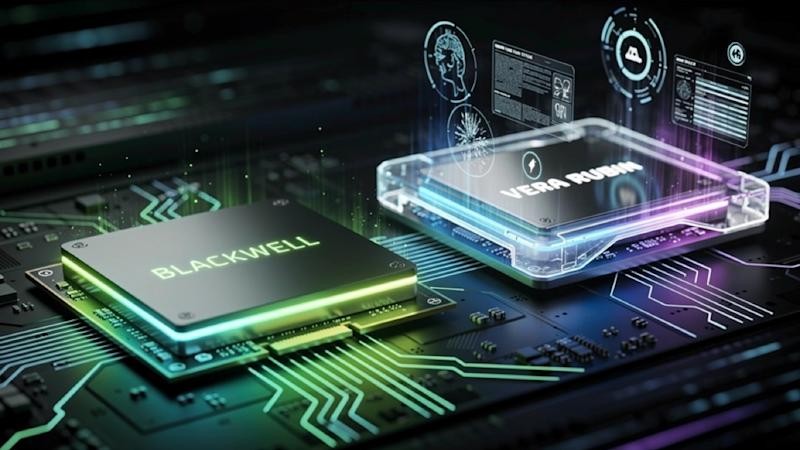
Nvidia is aggressively improving its current AI hardware, Blackwell, even as it prepares for the next generation, Vera Rubin. While the highly anticipated Rubin GPU won’t arrive until late 2026, existing Blackwell systems are seeing significant performance boosts right now through software optimizations. This strategy allows enterprises to maximize their investments in current infrastructure while preparing for the future.
Blackwell’s Rapid Evolution
Nvidia is not waiting for new hardware to deliver value. The Blackwell architecture, released in 2024, is already being enhanced with optimizations for both inference and training workloads. In just three months, Nvidia increased Blackwell’s inference performance by up to 2.8x without requiring any hardware upgrades. This is achieved through innovations in the TensorRT-LLM inference engine, including:
- Programmatic Dependent Launch (PDL): Reduces kernel launch latencies for faster throughput.
- All-to-All Communication: Streamlines data transfer by eliminating unnecessary buffers.
- Multi-Token Prediction (MTP): Generates multiple tokens per forward pass, improving efficiency.
- NVFP4 Format: A 4-bit floating-point format that reduces memory bandwidth without sacrificing accuracy.
These optimizations translate into lower costs per million tokens and higher throughput for cloud providers and enterprises.
Training Gains with Blackwell
Blackwell’s improvements aren’t limited to inference. Training performance has also seen a 1.4x boost in just five months, thanks to optimized training recipes that leverage the NVFP4 precision. This demonstrates Nvidia’s commitment to continuous innovation beyond initial hardware deployments.
Vera Rubin: The Next Leap
Despite Blackwell’s gains, Nvidia is already looking ahead to Vera Rubin, slated for release in the second half of 2026. According to Nvidia’s internal testing, Rubin promises transformational improvements:
- Training large models in one-quarter the number of GPUs.
- 10x higher throughput per watt for inference.
- Inference at one-tenth the cost per token.
These metrics suggest that Vera Rubin will dramatically reduce the economics of AI operations at scale, enabling more capable and efficient models.
What This Means for Enterprises
For organizations deploying AI infrastructure today, Blackwell remains a sound investment. Existing deployments can immediately benefit from the latest software optimizations, delivering cost savings without capital expenditure. However, enterprises planning large-scale infrastructure buildouts should factor Vera Rubin into their roadmaps.
The key takeaway is that Nvidia is offering a phased approach: maximize value from current Blackwell deployments while preparing for the next generation. This isn’t an either/or decision, but rather a strategy to remain competitive in the rapidly evolving AI landscape.
Nvidia’s continuous optimization model ensures that enterprises can extract maximum value from their current investments while positioning themselves for the future with the upcoming Vera Rubin architecture.