The Super Bowl isn’t just a football game anymore; it’s a massive technological showcase. A week inside Levi’s Stadium in Santa Clara, California, reveals how cutting-edge technology ensures a seamless experience for both in-person fans and the millions watching at home. From high-end broadcast equipment to custom-made coach headsets, the event depends on a complex network of systems running flawlessly. Here’s a breakdown of what goes into powering the biggest sporting event in the US.
Capturing and Broadcasting the Game
The Super Bowl broadcast relies on a sprawling infrastructure. Two dozen NBC production trucks house hundreds of workers who stitch together the live feed for television viewers. Inside, switchboards pulse with activity, and screens display a constant stream of footage. The technical director, producer, and director work in tandem to ensure the right shots are broadcast, while an assistant director manages the timing of high-priced Super Bowl ads.
The audio mix is equally critical. Engineers can manipulate the visuals in real-time – adjusting grass color or seat hues with a dial, ensuring the picture remains vibrant even as sunlight shifts. Replay trailers allow for instant slowdowns, crucial for both viewers and officials reviewing calls. To speed up production, the crew preloads footage from previous games, ready to deploy at a moment’s notice. A direct pipeline connects the Santa Clara site to NBC’s production facility in Connecticut, delivering clips in as little as 15 seconds.
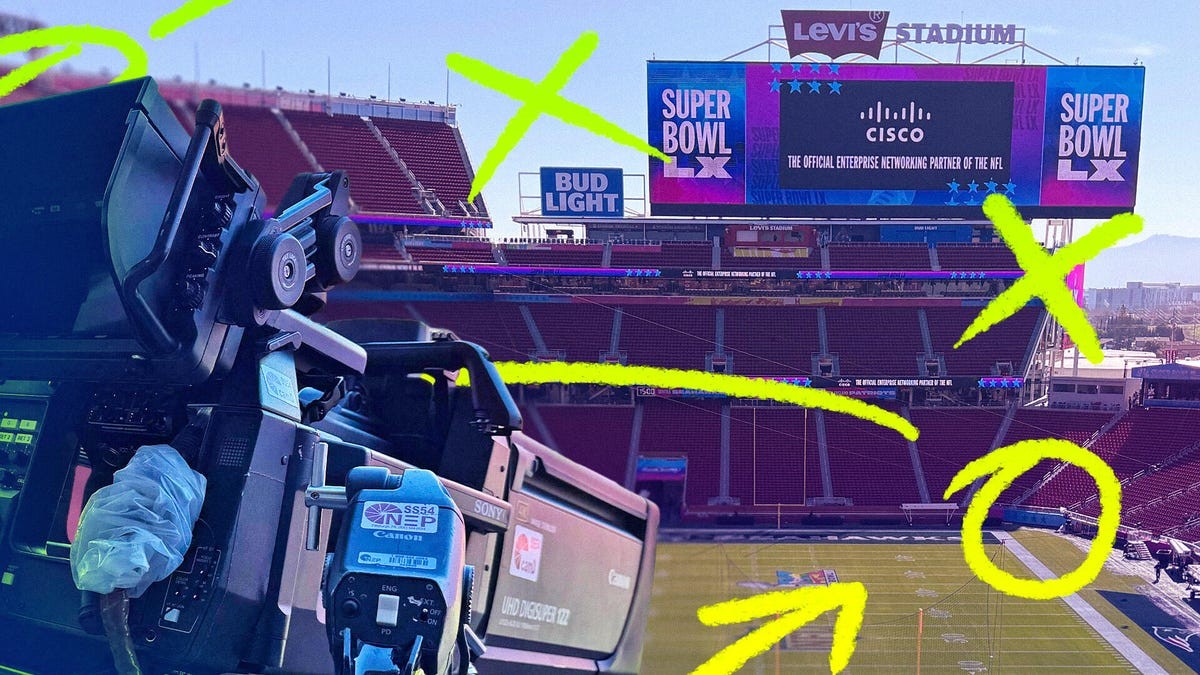
The broadcast relies on over 120 Sony cameras, including high-frame-rate models for smooth replays. Around 150 microphones and 75 miles of fiber cables support the transmission.
NFL-Grade Communication: Sony’s Custom Headsets
This year marks the first Super Bowl using custom-designed NFL headsets developed in partnership with Sony. Engineers spent two years perfecting audio clarity and noise cancellation, so coaches can communicate clearly amidst roaring crowds. The headsets are built to withstand abuse, including accidental drops and extreme weather conditions – tested in freezers and rain during development. Comfort is also key; the padded design feels like “a cushiony pillow,” ensuring coaches can wear them for hours without discomfort.
Sound Systems Engineered for Impact
Sound engineer Johnny Keirle designed the L-Acoustics sound system for this year’s Super Bowl, working with ATK Audiotek to ensure consistent audio quality throughout the stadium and on home televisions. Levi’s Stadium presents unique acoustic challenges due to its large, asymmetrical shape. Keirle’s team submitted initial plans in May, refining them over months. The open-air design helps minimize sound reflections, but setup time on the natural grass field is limited, requiring meticulous preparation.
Speakers are wheeled onto the field just before performances, loaded with subwoofers and line arrays to amplify every corner of the stadium. The crew expects Bad Bunny’s halftime show to push the system to its limits.
Wi-Fi 7: The Next-Generation Fan Experience
Levi’s Stadium is rolling out Wi-Fi 7, the latest wireless standard, for the first time during the Super Bowl. This upgrade provides faster speeds and lower latency, enabling fans to instantly share experiences online. The network includes 1,200 access points, with a couple hundred added specifically for the event. The NFL’s wireless engineering director, Anish Patel, describes it as “one seamless adventure,” extending from ticket scanning to concessions. The stadium previously recorded 90% upload activity during Taylor Swift’s Eras tour in 2023, and expects to break that record on Sunday.
Security: A Multi-Agency Effort
The Super Bowl is classified as a SEAR 1 event, requiring extensive federal support. Security operations are centralized in a dedicated room, monitoring for cyber threats and physical breaches. The center displays data from Cisco’s Splunk, Umbrella, and Secure Firewall products, identifying suspicious activity in real-time. Hundreds of security cameras provide live feeds to NFL and law enforcement personnel, who monitor for bottlenecks and potential incidents.
In short, the Super Bowl is a high-stakes event that demands precise execution across every technical domain. The combination of advanced broadcast technology, custom communication gear, robust sound systems, next-gen wireless infrastructure, and multi-agency security ensures the game runs smoothly for fans worldwide.