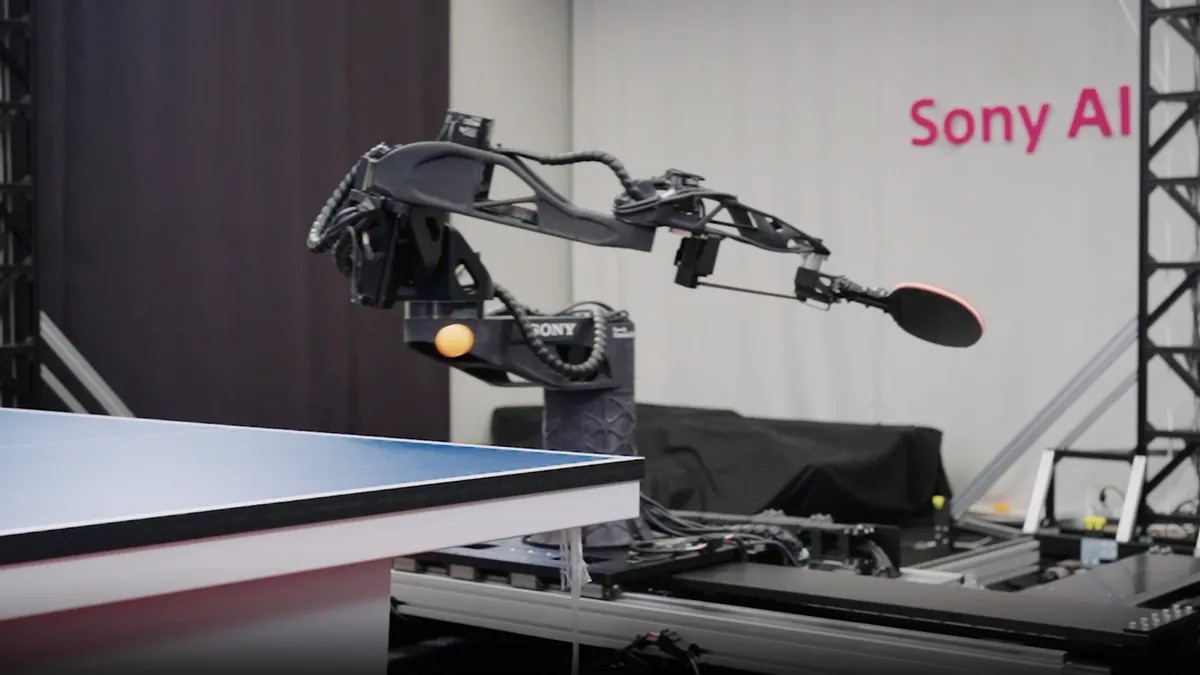
Sony has officially entered the arena of high-performance robotics with the announcement of Project Ace, an autonomous robot designed to compete at a professional level in table tennis. This development marks a significant milestone, moving AI beyond digital screens and into the complex, unpredictable realm of physical movement and real-time reaction.
Beyond Digital Intelligence: The Rise of Physical AI
While much of the current technological discourse focuses on “agentic AI”—software agents that can manage digital tasks like scheduling or coding—Sony is pivoting toward Physical AI.
This shift is crucial. Unlike a chatbot that processes text, a physical AI must navigate the laws of physics, gravity, and momentum. Table tennis serves as a perfect stress test for this technology because it requires a rare combination of:
– Extreme speed: Reacting to high-velocity projectiles.
– Precision: Executing micro-movements with millimeter accuracy.
– Complex Decision-Making: Predicting spin, trajectory, and opponent behavior in milliseconds.
How Project Ace Works: Sensors and Learning
Project Ace is not merely a programmed machine following a set of rules; it is a sophisticated system capable of independent adaptation. Its performance is driven by three core pillars:
1. Advanced Sensory Perception
To “see” the game, Ace utilizes nine active pixel-sensor cameras. This setup allows the robot to map the ball’s position in 3D space with incredible accuracy. Additional camera systems work in tandem to calculate the ball’s velocity and the complex spin that defines professional-level play.
2. Model-Free Reinforcement Learning
Unlike traditional robots that rely on pre-programmed instructions for every possible scenario, Ace uses model-free reinforcement learning. This means the AI learns through experience, allowing it to adapt to unexpected ball trajectories or shifts in play without needing a human to code a specific response for every eventuality.
3. High-Speed Hardware
The intelligence of the system is matched by its physical capabilities. High-speed robotic hardware allows the machine to translate digital decisions into lightning-fast physical movements, bridging the gap between thought and action.
Testing the Limits: Results Against Human Pros
Sony put Project Ace to the test against human players to measure its true competitive standing. The results suggest that the gap between human expertise and machine precision is closing rapidly:
- Match Performance: In a series of tests against five elite players, Ace won three out of the five matches.
- Serving Dominance: During serves, Ace demonstrated superior efficiency, scoring 16 direct points compared to just 8 from the elite human players.
Why This Matters for the Future
The success of Project Ace is more than a feat of engineering; it is a proof of concept for a new class of real-world applications. As Peter Stone, Chief Scientist at Sony AI, noted, once AI can operate at an expert human level in highly dynamic environments, it unlocks possibilities in fields that were previously considered too complex for automation.
This technology could eventually transition from the ping-pong table to more practical, high-stakes industries such as precision manufacturing, emergency response robotics, or advanced surgical assistance, where split-second physical decisions are a matter of success or failure.
Conclusion
Sony’s Project Ace demonstrates that AI is successfully breaking out of the digital world and mastering the physical one. By proving that machines can compete with elite human athletes in high-speed environments, Sony has opened the door to a future where physical AI handles increasingly complex real-world tasks.