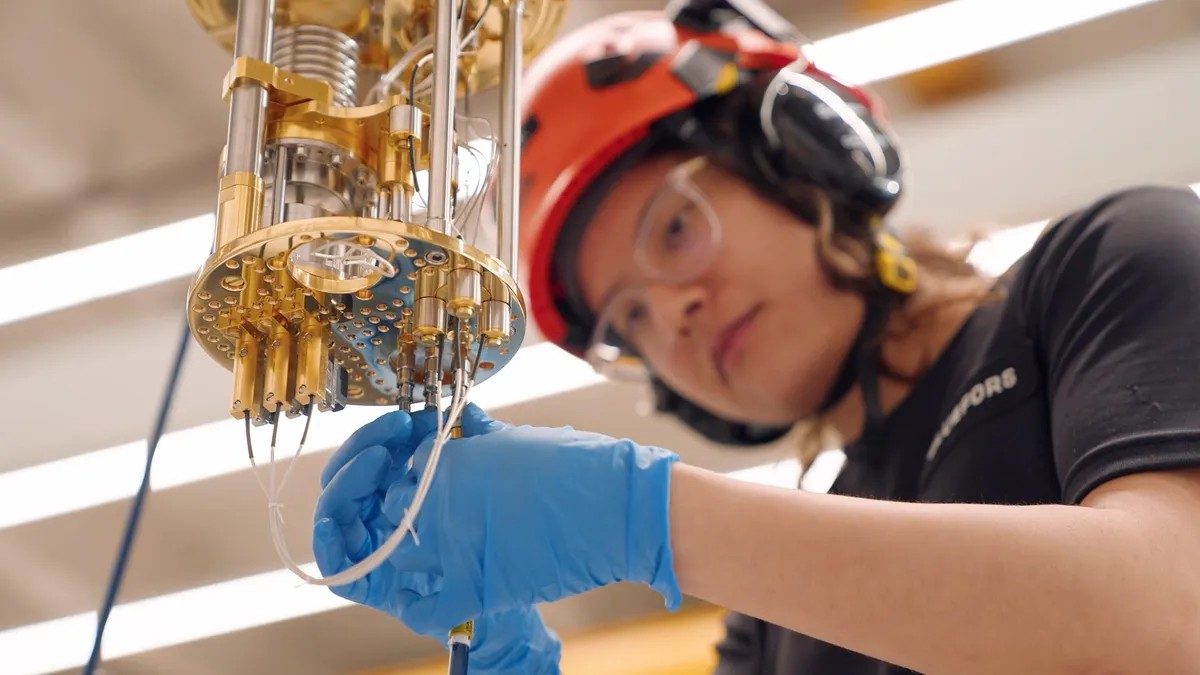
Quantum computers, often depicted as futuristic machines, rely on an extreme and counterintuitive requirement: near-absolute zero temperatures. The elaborate, chandelier-like structures surrounding them aren’t the computers themselves, but rather the massive refrigeration systems that keep the core components functioning.
The Challenge of Quantum Stability
The necessity of these frigid conditions stems from the fundamental nature of qubits, the basic units of quantum computation. Unlike classical bits (0 or 1), qubits exist in a superposition – a blend of both states simultaneously. This allows quantum computers to perform certain calculations far faster than classical machines.
However, this delicate quantum state is easily disrupted by external influences, most notably heat. Even the slightest thermal vibration can cause qubits to “decohere,” collapsing their superposition and leading to errors. To maintain coherence long enough to perform meaningful calculations, qubits must be shielded from virtually all thermal energy.
Colder Than the Coldest Place in the Universe
The temperatures required are astonishing. Most quantum computers operate at less than 1 degree above absolute zero (-273.15°C or -459.67°F). For context, the Boomerang Nebula, the coldest natural place in the universe, registers at around 1 Kelvin (about -272°C). Quantum computers routinely surpass this, pushing the boundaries of cryogenic engineering.
This extreme cooling isn’t merely a technical hurdle; it’s a fundamental limitation of current quantum computing architectures. Until new qubit designs or error-correction methods emerge, maintaining these temperatures will remain essential for progress in the field.
The need for such extreme conditions highlights how early quantum computing is in its development. While the potential benefits are immense, the practical challenges are equally daunting. The race to build more stable and scalable quantum computers hinges on overcoming this deep-freeze requirement.