CNET’s television reviews are widely respected in the industry, but the process behind them is far more complex than most consumers realize. The core principle is direct comparison: TVs are lined up side-by-side, measured with specialized equipment, and evaluated by trained experts to determine which models deliver the best viewing experience. This article breaks down exactly how CNET approaches TV testing in 2026, from the high-dollar equipment used to the subjective judgments that shape the final verdict.
The Testing Environment and Equipment
The foundation of CNET’s TV reviews is a controlled testing environment. The lab itself is designed to minimize external interference: dark gray walls and ceilings reduce light contamination, while blackout curtains allow for precise measurements in complete darkness. This isolation is critical because ambient light significantly alters perceived image quality, especially black levels.
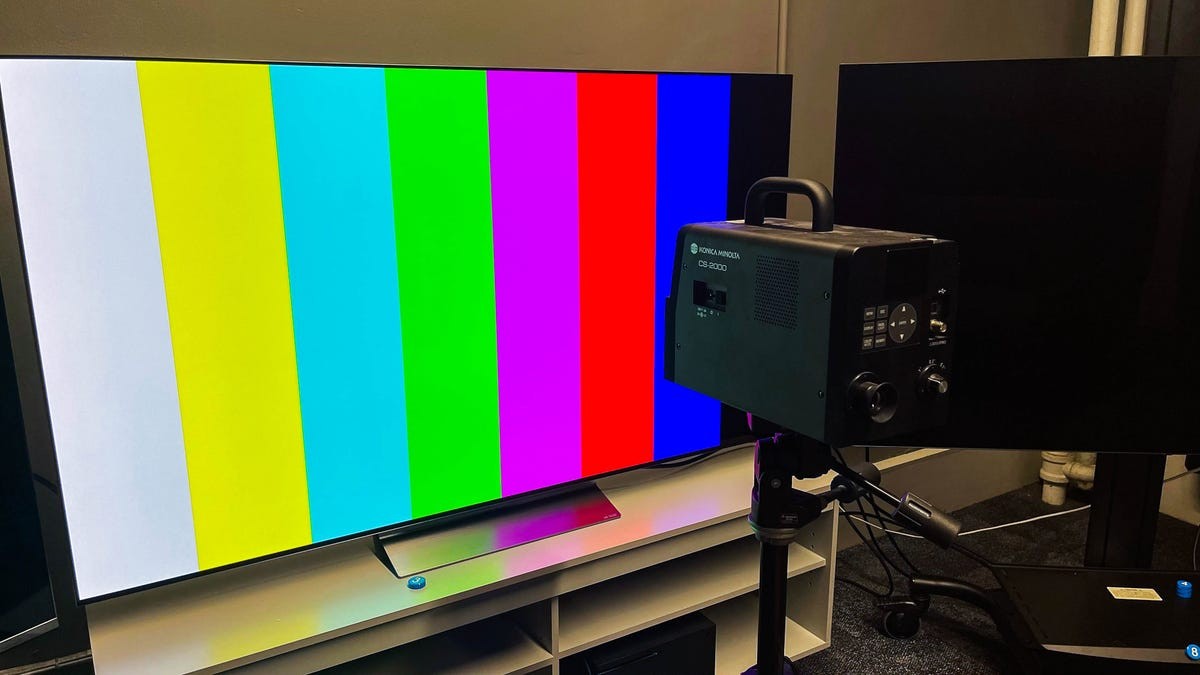
The most crucial piece of equipment is the Konica Minolta CS-2000 spectroradiometer, a $28,000 device that measures luminance and color with extreme accuracy. But precision instruments are only part of the equation. CNET relies on the expertise of veteran reviewers like David Katzmaier and Ty Pendlebury, who bring years of experience in display calibration and evaluation.
Beyond the spectroradiometer, CNET utilizes an arsenal of tools:
- Murideo 6G: A signal generator that outputs test patterns for accurate measurement.
- AVLab DVDO TPG and Quantum Data 780: Secondary signal generators for quick checks.
- Murideo 6A: A signal analyzer to verify HDR and bandwidth capabilities.
- Konica Minolta LS-100: A handheld luminance meter for spot-checking brightness.
- AVPro 8×8 4K UHD Matrix Switch: Distributes HDMI signals to multiple screens simultaneously for side-by-side comparisons.
- Leo Bodnar Lag Tester and 4K HDMI Video Signal Lag Tester: Measures input lag for gaming performance.
- 4K Blu-ray Players (Oppo BDP-203, Sony UXP-700): Used for reference material and TV comparisons.
- Gaming Consoles (Xbox Series X, PlayStation 5): For testing gaming features, including 4K/120Hz and VRR.
- Streaming Devices (Apple TV 4K, Roku Ultra): For evaluating streaming performance.
Software and Testing Procedures
CNET’s testing relies on sophisticated software to interpret the data gathered by its equipment. Portrait Displays Calman Ultimate controls the spectroradiometer and signal generators, providing detailed reports on color accuracy, brightness, gamma, and other key metrics.
The testing process itself has evolved. CNET no longer calibrates TVs before testing, as most consumers don’t bother with professional calibration. Instead, reviewers evaluate the “out of the box” picture settings to provide a more realistic comparison.
The core steps include:
- Measurement: The spectroradiometer measures every picture mode in both SDR and HDR. The most accurate modes (usually Movie or Cinema) are selected for comparison.
- Side-by-Side Comparison: TVs are lined up and fed the exact same signal via the AVPro switch. Reviewers record observations on a laptop, noting differences in brightness, color accuracy, black levels, and motion handling.
- Image Quality Tests: The TVs are subjected to a range of tests:
- TV and Movies: Reviewers watch HDR and SDR content from Blu-ray and streaming services.
- Gaming: Gaming performance is assessed using the Xbox Series X and PlayStation 5, including input lag measurements.
- Bright Lighting: The TVs are tested in a brightly lit room to evaluate their ability to handle glare and maintain contrast.
- Uniformity and Viewing Angle: Reviewers check for screen uniformity and off-angle color shifts.
Finally, CNET publishes a “Geek Box” with objective test results, including color accuracy (DeltaE 2000), black luminance, and other key metrics. These results are categorized as Good, Average, or Poor based on industry standards.
Awards and Recognition
CNET awards two main distinctions to top-performing TVs: Editors’ Choice and CNET Labs Award. Editors’ Choice recognizes the best overall products across various price points. The CNET Labs Award is given to TVs that excel in specific, repeatable metrics, such as brightness or color accuracy. The Labs Award for Best Color Accuracy, introduced in 2025, is determined by averaging three key color measurements: SDR color error, SDR grayscale error, and HDR color error.
The Importance of Rigorous Testing
CNET’s thorough testing methodology is essential because the TV market is saturated with competing technologies and marketing hype. Without objective evaluation, consumers would struggle to distinguish between genuinely high-performing TVs and those that simply look good on paper. The combination of advanced equipment, expert reviewers, and standardized procedures ensures that CNET’s recommendations are based on solid evidence, not just subjective impressions.
The process is not perfect, as sample variation and potential manufacturer interference can introduce uncertainty. However, CNET’s commitment to transparency and rigorous testing makes its reviews a valuable resource for consumers seeking the best possible viewing experience.