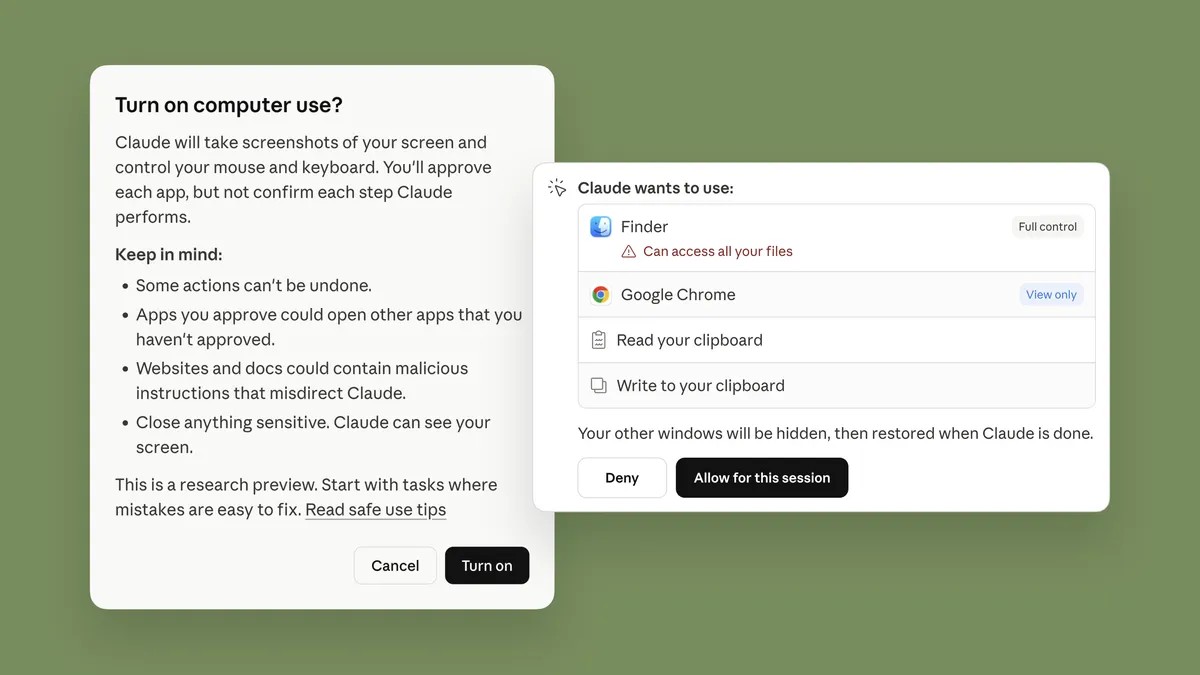
Anthropic has just released a feature allowing its Claude AI model to directly control a user’s computer. The update, rolled out Monday, grants Claude the ability to perform tasks such as file retrieval, calendar management, and even manual operation of applications via keyboard and mouse input. This marks a significant step toward more autonomous AI agents that can act independently on user devices.
The Rise of Agentic AI
The move follows the rapid development of open-source frameworks like OpenClaw, which demonstrated the feasibility of AI models interacting with computer systems in a more hands-on manner. Nvidia’s recent launch of NemoClaw further accelerates this trend by simplifying the setup and integration of such tools.
Anthropic’s Claude will connect to existing applications (Google Calendar, Slack) when possible, but can also simulate human actions – scrolling, clicking, typing – when necessary. The AI will always request permission before executing a task, and users can halt operations at any time.
Convenience vs. Security Risks
While convenient for automating workflows, the new feature raises immediate security concerns. Experts warn that agentic AI can execute actions quickly and with limited oversight, making systems vulnerable to exploitation. A compromised AI agent could potentially access sensitive data or perform unintended actions before a user can intervene.
Anthropic has implemented safeguards against prompt injection and other vulnerabilities, but acknowledges the system may still contain errors. As a precaution, the company advises against using the feature with applications handling critical or confidential information, even disabling some by default.
Early Access & Future Development
The computer control feature is currently available as a research preview for Claude Pro and Claude Max subscribers on MacOS. It integrates with Anthropic’s Dispatch app, allowing users to assign tasks remotely via their smartphones – like automated email checks or session launches.
Anthropic emphasizes that this is an early-stage release designed to gather user feedback and refine the system. The goal is to create a more powerful and reliable AI tool, but the immediate implications are clear: AI is no longer confined to chat windows; it can now act directly in your digital environment.
Despite its early stage, this development signals the next phase of AI evolution, where machines move beyond passive assistance to proactive, system-level control.